Showing posts with label History. Show all posts

Friday, July 4, 2025

How liberals should celebrate the Fourth

Fireworks at the Navy Yard in DC, 2024

Folks on the left are often accused of being less patriotic than conservatives.  There's something to this.  Every year, Gallup asks us questions about our feelings for the USA. This year, 92 percent of Republicans said they were extremely or very proud to be an American. Only 36 percent of Democrats feel that way. 

Trump has something to do with this, but the gap was still wide in the middle of the Biden administration, 52-36. And Republicans even had an 8-point edge in the Dems' most patriotic year of the Obama administration. The younger they get the less patriotic.  Gen Z Democrats were 42 percent less proud to be Americans than the oldest cohort of Dems over the last five years.

Why is this?  Many reasons, I'm sure, but here's one I've observed first hand in studying and teaching US history over the past 37 years, and as a parent of three children.  You might call it the Howard Zinnization of the American history curriculum. 

From what I can see Howard Zinn's very popular book "A People's History of the United States," has influenced a majority of teachers now teaching US history, and might be the single most popular book to assign in their history classes. To quote the website of the Howard Zinn Project: 

The Zinn Education Project promotes and supports the teaching of people’s history in classrooms across the country.... With more than 168,000 people registered, and growing by more than 10,000 new registrants every year, the Zinn Education Project has become a leading resource for teachers and teacher educators.

Zinn's book was first published in 1980, sold 4 million copies by 2022, has been translated into a dozen different languages, and was adapted for children and assigned to my my daughters in middle school.  Here's what Zinn had to say that was relevant to the topic of national pride in the original edition of his book (which, yes, I own):

We must not accept the memory of states as our own. Nations are not communities and never have been.  The history of any country presented as the history of a family conceals fierce conflicts of interest … between conquerors and conquered masters and slaves, capitalists and workers, dominators and dominated in race and sex. And in such a world of conflict a world of victims and executioners, it is the job of thinking people as Albert Camus suggested, not to be on the side of the executioners.

We've seen the problem with this thinking in recent years, as the left has been divided into a circular firing squad more intent on dividing itself into victims and oppressors so the latter can be cancelled, and some have exited the left in response.  The Philosopher Richard Rorty forsaw this way back in 1998 in his wonderful antidote to Zinnism, Achieving Our Country, a book that liberals and leftists should read in the town square every Fourth after they recite the Declaration of Independence: we should 

refrain from thinking so much about otherness that we begin to acquiesce in what Todd Gitlin has called, in the title of a recent book, "the twilight of common dreams." It means deriving our moral identity, at least in part, from our citizenship in a democratic nation-state, and from leftist attempts to fulfill the promise of that nation.

The cultural Left often seems convinced that the nation-state is obsolete, and that there is therefore no point in attempting to revive national politics. The trouble with this claim is that the government of our nation-state will be, for the foreseeable future, the only agent capable of making any real difference in the amount of selfishness and sadism inflicted on Americans.

We of the Leftnot the environmentalist left or the LBGTQ left or the feminist left or the labor left or the progressive or moderate leftbut a broad left-of-center coalition capable of winning national elections have to believe that we are capable of moving the country toward a better future—like Lincoln and Roosevelt did. Otherwise, we abandon the government to a Right that seems to want more, not less selfishness and sadism. 

Notes

For some thoughts about reasons to feel patriotic about America, I recommend Isaac Saul's essay for Independence Day 2025  "Do I love America? On patriotism and my country," on the Tangle website. It includes a link to the Tangle podcast version where he reads the essay. Also, "How Democrats Can Maintain Their Patriotism in the Trump Era," by Michael Baharaeen on the Liberal Patriot Substack. And Yasha Mounk giving an outsider's view of his adopted country.


Wednesday, December 25, 2024

Effervescent Christmas

This ad appeared in the Boston Globe during the Christmas shopping season of 1919. Note the enticement to become consumers rather than producers of music.

The assembly hall at Phillips Exeter Academy is usually the site of serious, sometimes grim, subjects: global warming, war, poverty, the Supreme Court.

Last Friday, one of our music teachers, Eric Sinclair, got up on stage and sang Christmas carols.

This assembly used to be an annual event, but it hadn’t happened for long enough that the current students had never experienced it. I never heard an explanation for why it was stopped, but I’ve assumed that, in the spirit of diversity and inclusion, we had decided that the “harm” it might do to people who don’t celebrate Christmas was more important than the “collective effervescence” it inspires among those who know the words to the songs.

Was this experience of joining together with others in song more common before Netflix and doom scrolling? Before we traded in our pianos for record-players? Before we all had our own Spotify playlists and air-buds? Did we know the words to more of the same songs and sit around the fire or the piano and sing together?

Christmas and Christmas songs seem to be one of the few things that still permeate our national culture down through the generations. After the assembly, Eric said he wasn’t sure this youngest generation would know the words. They did.

They belted out “Deck the Halls,” and “”Jingle Bells,” and when Eric sang “had a very shiny nose,” they even knew to shout back: “like a light bulb!”

Adam Grant guessed that the numbers of depressed Americans quadruped during COVID quarantine because we were being denied “a special kind of joy.”

“Peak happiness,” he said, “lies mostly in collective activity.”

Grant’s NYT op-ed is where I learned the term collective effervescence. “We find our greatest bliss in moments of collective effervescence,” he wrote.

According to my AI friend, Gemini, the term was coined by Emile Durkheim in 1912 and describes the feeling of energy and harmony that people experience when they come together in a group with a shared purpose. It is a joie de vivre that manifests when we share moments with others, such as being in a stadium that erupts in simultaneous applause when a musician returns for an encore performance.

Grant described the feeling more broadly to include “creating together and solving problems together.” He chided Americans for thinking that the pursuit of happiness is a solitary endeavor and called for a “Declaration of Interdependence.”

Unfortunately, the end of pandemic lock-downs didn’t end what the surgeon general calls our loneliness epidemic. And there’s no end in sight.

It seems like every new invention and every social trend has the effect of pushing us away from each other. My parents’ first home was just around the corner from both of my grandparents. Then we moved to the suburbs. By the end of the day on Christmas, nine people will have spent a combined 60 hours driving to our holiday celebrations over the last few days in search of an effervescent Christmas.

I hope we were wrong about the harm these songs might cause.  I can't recall a single religious theme in the lyrics Eric sang. They were all about decking the halls and dashing through snow.  And one song at the end had an inclusive message, about German and British soldiers playing soccer during a Christmas truce in 1914.  The assembly ended with these words: On each end of the rifle we're the same.

Sunday, September 22, 2024

Watching "Babylon Berlin"


 When I first started teaching high school I was struck by how skilled my students were at using Hitler analogies to make a point. It turns out that someone named Goodwin noticed a similar tendency in online discussions and invented a term for it, which he named after himself.  Hitler is a pathetic way to make an argument. It's an impulse that leads to things like mustachioed pictures of Obama or Trump and should be avoided by all intelligent, fair-minded people, even in 9th grade.

As I begin my fourth sabbatical, however, I must confess that I have a tendency to succumb to my own personal corollary to Goodwin's Law:

"As I devote more time to reading, the probability of picking up a book on Germany between the wars approaches 1."

This sabbatical it was Richard Evans' The Coming of the Third Reich. As it happens, my daughter was watching "Babylon Berlin," so I also ended up re-watched seasons 1-3 with her, and now we are into the new season 4.

Watching that show about 1920s Berlin after reading Evans helped me make more sense of the complicated plot of the series. And it made what I'd read in Evans about that period come alive.

I found an encyclopedic fan website (historica.fandom.com) that explains the plot, the characters, and the background. I highly recommend this series, and if you do tune in, the website helps to make sense of the complicated characters and plot. Also, TVTropes.org has BB character summaries—don't click on the white redactions; they are spoilers. There are a few real characters mixed into the plot and the fan site doesn't clearly distinguish between them, so it's good to use Wikipedia to separate truth from fiction.

It's satisfying to be watching a TV show and suddenly notice a character you've just read about in a history book. Gustav Stresseman, the Wiemar foreign minister, appears a couple of times, winning the Nobel Peace Prize and surviving an assassination attempt. (The show's protagonist, Gereon Rath, saves him from a fictional plot in 1929—the real attempt happened in 1925.) Evans wrote that Stresseman was the Weimar Republic's "most skilled, most subtle and most realistic politician." He was a monarchist, but he was willing to participate in democratic politics and he was able to build a bridge between the anti-democratic nationalists and the Social Democrats. His death in 1929, coinciding with the crash of the US stock market, made the rise of the Nazis more likely. Those two events are the hinge between seasons 3 and 4.

The film also reinforces the most significant impression I took away from the book, Evans' case for contingency. In the film, we don't know how things will turn out and the good guys are determined, smart, and effective. They face many obstacles, but they have a way of defeating the villains. Evans also tells us that the rise of a viciously racist fascist regime in Germany leading to World War and Holocaust was not the inevitable fruit of German history and culture and the politics of Weimar, which has been a common assumption of most post-war writing about the rise of German antisemitic fascism. In fact, just before the market crash triggered the depression, he writes, Germany's experiment in democracy "seemed to have weathered the storms of the early 1920s" and was entering "calmer waters. It would need a catastrophe of major dimensions if an extremist party like the Nazis was to gain mass support" (230). After the stock prices crashed, German unemployment rose from 4.5% to 24%.

Before 1914 Evans claims, if you had to predict which European country would have created the Holocaust, it would have been France, not Germany. The film does portray lots of antisemitism in the Wiemar period, but it was by no means universal. Jewish characters hold important positions and are respected and admired by the film's protagonists. Nor was the persecution of homosexuals an inevitable product of German culture. The film's depictions reflect the fact that Berlin was the most tolerant city for gay culture in Europe during the 1920s.

I've been repeatedly drawn to this history because of what Germany's failed experiment in republican government tells us about the vulnerabilities of democracy in the face of a version of right-wing populism with certain parallels to the present. The idea that democracy is fragile has become painfully obvious in the 21st century and historians like Jason Stanley and Timothy Snyder have been showing us scary parallels between the Nazis and Trump since at least 2016.

In a parallel that was hard to ignore, Evans begins his chapter on "Culture War," saying that Germans in the 20s "suffered from an excess of political engagement and political commitment . . . no area of society or politics was immune from politicization" (392-395). In recent years, Americans have politicize personal identity, pregnancy, school libraries, and even Thanksgiving dinners. As my new favorite political thinker writes, "the attempt to politicize everything is the destruction of politics" (Crick, 151).

And yet, Evans' point about contingency is well taken. The differences between America today and Germany in 1929 could not be greater. Our democracy is not new and was not imposed on us by hated conquering foreigners. The US Constitution has deeply ingrained roots and its principles are baked into civic culture. We don't have a violent revolutionary leftist movement like the German Communist Party, loyal to a foreign enemy nation and dedicated to overthrowing the system—Antifa notwithstanding. We aren't suffering in the aftermath of defeat in a war that wiped out 2.7 millions countrymen, paying reparations to our subjugators. And even if the Fed fails to avoid a recession, it is unlikely that we will end up with 24% unemployment.

In short, Weimar Germany is not a road map of our future, and Trump is a bad guy in his own unique way. Don't draw a mustache on him.


Source: Bernard Crick, In Defence of Politics.

Monday, August 14, 2023

Should we teach social justice?

(Second in a series: Could I Be Wrong?  Believe Science? 11 Strategies for Depolarizing Tomorrow's Citizens)

Diversity, equity, inclusion, social justice. Who could be against any of these things?

Protest movements for social justice are undeniably an essential element of democracy. My book looks at African American social justice advocacy during World War I and my US history courses spend a lot of time on how social movements improved American democracy. From time to time, I’ve joined campaigns for contemporary causes.

In the absence of protest, modern representative democracies act almost exclusively in the interest of the classes that control the levers of government—at best about 20 percent of the population. Only under pressure from protest movements do they sometimes throw the bottom 80 a bone. The history of American democracy is unthinkable without the abolition, women’s suffrage, labor, and civil rights movements.

But while I want my students to understand the role those movements played in history, I think it would run counter to my role as a teacher to recruit them into a movement that I support or to embrace one particular vision of social justice. I know that many of my colleagues disagree with me about this. And it has often seemed that my school does too.

But we don’t all agree on the same vision of social justice. If teachers can promote a particular partisan agenda, half the nation’s schools will cultivate right-wing crusaders, and the other half will produce left-wingers, and the electorate will become ever more polarized.

And the dispositions, inclinations and tactics of citizens are the opposite of those required for a political campaign. Where citizens should be open minded, aware of the likely flaws in their thinking and open to compromise, activists and campaigners must suppress their doubts as they crusade for the cause.

I do think it’s possible to play the role of citizen in a spirit of “political friendship” with rivals and still campaign for certain partisan outcomes—but it’s essential to understand the difference between the two and to be able to make the shift into the different roles as appropriate.*

As a teacher at Exeter I try to be as politically neutral as possible in the classroom. When students try to guess my politics, they are wrong more than half the time. But in my free time, I helped students canvass for Bernie Sanders in the 2016 and 2020 New Hampshire primaries. These students came to support Sanders on their own. I just gave them rides in my car—which still has a “Feel the Bern” bumper sticker.

Meanwhile, in the classroom, I make a special effort to support conservative students because they are in such a small minority at the school and I value their presence because it makes for a more realistic political environment in my classroom. They also improve the thinking of liberal students by forcing them to defend their positions.

But we are increasingly living in ideological bubbles. The US is “more geographically polarized today” by party affiliation “than at any point since 1860.”  Which means that public schools have less ideological diversity, and students encounter fewer people with different viewpoints than their parents. Private—especially boarding—schools might offer more diversity, since they can bring students together from different communities, yet they seem to be getting more polarized as well, as Michael Powell showed in his reporting on liberal, elite New York City independent schools and as the recent 12% rise in enrollments in conservative Christian schools suggests.

Teachers can open students’ minds to opposing views by playing the devil’s advocate. But that’s less useful in helping students develop cognitive empathy than encountering real people with sincerely held views (Hess and McAvoy, 117). But in a school where the devil’s advocate is seen as an actual devil, teachers may be wary of making his case.

For example, during a DEI faculty workshop I attended, I posed a question to the presenter we had invited to speak. How do we protect the feelings of African-American students in a discussion about Affirmative Action? I was concerned that the conversation might turn to questions about the qualifications of students at our highly selective school who might be perceived as beneficiaries of racial preferences.

His answer: the teacher should intercede in the debate and explain why the student opposing affirmative action is wrong.

I agree that some opinions should not be given serious consideration in any classroom. But an important difference between, say, slavery and affirmative action is that one is a settled question in contemporary national politics, and the other is still open and subject to debate. A majority of the US population and the Supreme Court and a significant minority of African Americans oppose affirmative action according to some polls, and opponents raise legitimate questions about its effectiveness.

If we shut off debate on unresolved questions, how will we resolve them if not through violence and intimidation, or the suppression of basic political rights? And if they can be discussed in Congress and the courts and the nation’s press, to shut them down in schools is to prepare students for a political fantasy world.


Things to read in relation to the above. 

The other Blog posts in this series: Could I be Wrong? Believe Science? and 11 Strategies for Teaching Politics.

I wrote on this topic back in 2022.  See "On Teaching Social Justice."  Here's a passage: "To advance any version of social justice in a democracy (or republic, if that’s your preferred term), we need to be willing and able to deliberate, compromise and form coalitions with fellow citizens and that requires mutual respect even between rivals. The best contribution teachers can make to advancing social justice is to graduate citizens with that sort of democratic disposition."

*In The Spirit of Compromise: Why Governing Demands It and Campaigning Undermines It, Amy Gutman and Dennis Thompson argue that in a representative democracy elected leaders need to be able to shift back and forth between campaign mode and governing mode if they want to govern effectively. One cause of polarization, they argue, is that US election seasons—especially for the presidency—last so long.

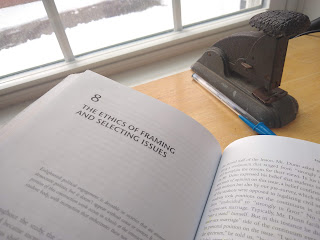
For a more useful answer to my question about affirmative action, see Hess and McAvoy, Chapter 5, “A case of Political Friendship,” which looks at the methods that a masterful teacher of politics, Joel Kushner, employed to “mitigate negative costs” in discussions of controversial topics. Also relevant to teaching affirmative action is chapter 8, “Ethics of Framing and Selecting Issues” which makes a helpful distinction between open and closed political debates and how to deal with them differently. I wrote a summary of the chapter here

Public opinion on affirmative action varies according to how the question is asked and who is doing the polling. This June, 2023 poll by Pew says 50% of Americans (including 29% of African Americans) oppose affirmative action in selective college admissions, while only 33% approve.  Like so many issues, if you search hard enough, you can find a poll to support many different positions on affirmative action, but you will never find one that suggests it is not still a matter of controversy. On the other hand, no one even bothers to run polls on whether slavery is a legitimate system of labor.

For an example of an essay that raises legitimate questions about the effectiveness of race-based affirmative action by an Exeter Latina student, see Nataly Delcid, “At private school, my family’s income sets me apart more than ethnicity,” Washington Post, July 12, 2023. She agrees with the 60% of surveyed Americans who told Rice University pollsters in 2019 that affirmative action should be based on family income not race or ethnicity.

Quite understandably, DEI training like the session I mentioned, often backfires. See “Is Your Company’s Diversity Training Making You More Biased?” Psychology Today, June 7, 2017.

According to a recent paper by the economists Ethan Kaplan, Jörg Spenkuch, and Rebecca Sullivan, the U.S. is more geographically polarized today than at any point since 1860, when a geographic cleavage in political preferences was about to send the nation into the Civil War.  See: “The Real Culprit Behind Geographic Polarization,” Atlantic, Nov. 26, 2018.

The term social justice is associated with left-wing causes, but conservatives have their own version of what is socially just—they just call it something different. Efforts in New Hampshire and Florida by conservative politicians to insert content from the conservative online propaganda website PragerU into public school curricula are no better than liberal teachers basing their history courses on content from the Howard Zinn Education Project.  See Steven Porter, “Top education official in NH recommends unaccredited PragerU course for academic credit,” Boston Globe, Aug. 9, 2023. See also my thoughts about the NYT 1619 project as a source for US history educators. 

 This series: Part 1: Could I Be Wrong?  (civics education and epistemic humility); Part 2: Social Justice?  (Teaching citizenship to students with different values) and Part 3: Believe Science?  (curbing meritocratic hubris in tomorrow's leaders); Part 4: 11 Strategies for Depolarizing Tomorrow's Citizens.

Tuesday, July 26, 2022

Teaching about economic inequality

I was listening to a podcast called Pitchfork Economics, when Thomas Picketty’s theory about the cause of inequality in capitalist economies came up (Wikipedia: “the rate of capital return in developed countries is persistently greater than the rate of economic growth, and that this will cause wealth inequality to increase in the future”). It’s a valid thesis, the podcasters said, but a better explanation can be found by playing the game of Monopoly, which was designed to teach kids about capitalism and how it works. The outcome of every game is that one person ends up with all the money and everyone else ends bankrupt.

Just a game you say? Maybe not.

According to Nick Hanauer, the host of the podcast, Monopoly and capitalism are both “non-ergotic systems,” governed by path-dependence (past events or decisions constrain later events or decisions), luck, and the compounding of advantages and disadvantages.

Not all games are non-ergotic, they noted.  Two equally skilled tic tac toe contestants will always end in a tie. Two good checkers players will end up winning an equal number of games over time. Those games are ergotic.

One difference between Monopoly and capitalism, Hanauer says: Monopoly is more meritocratic since every player begins with an equal amount of money.  At the start of adult life in American capitalism, there is a huge gulf between the best and worst off of us.  To replicate that system in the game, one player would start with $1.5 million, they estimate, another would start off in debt.  Most everyone else would be arranged above and below the median for 20-year olds (it's $13,900 for Americans under 35, according to one source, for for 20-year-olds, who knows?).  

Also, in actually-existing capitalism, once you get enough money you can spend it to change the rules in your favor.

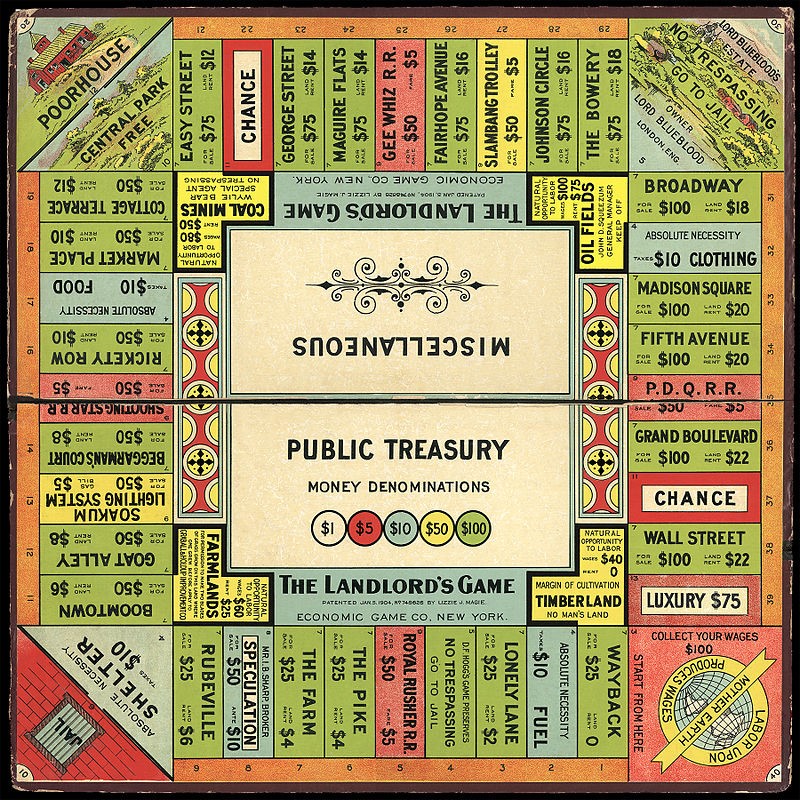
The next day I happened to catch the NPR show, “Throughline,” on the history of Monopoly. It was invented by Lizzie Magie, and patented in 1904 as “The Landlord Game,” to teach players “how rents enrich property owners and impoverish tenants” (Wikipedia). Today we seem to think of the game as a celebration of capitalism, but that was not Magie’s intent. She was a devotee of Henry George, a popular critic of free-market capitalism during the Gilded Age, and hoped playing the game would increase support for redistributive policys like George’s single tax on land. She also developed an alternate set of rules designed to show how a more just system would work (every player was rewarded when wealth increased in society).

I forwarded a version of this post to two economics teachers I know. Maybe they will have their students play Monopoly.

The Throughline episode also convinced me that Henry George probably deserves more attention than I give him in the winter term of US history.


Sources:

Mary Pilon, The Monopolists: Obession, Fury, and the Scandal Behind the World’s Favorite Game. 

"Do not Pass Go,”  Throughline, June 30, 2022.  Also interesting from the episode: During the Depression, Charles Darrow claimed to have invented the game in his basement (he was taught the rules by a friend) and sold it to Parker Brothers in 1934. Magie sued for patent infringement and was awarded a meger $500 for rights to the game. She mistakenly thought the Parker Brothers’ version would advance her anti-capitalist goals. In 1973, Ralph Anspach created a game he called “Anti-Monopoly” and was then sued by Parker Brothers.

“Ask Nick Anything,” Pitchfork Economics, July 5, 2022, @17:45-24:10

See also, on non-ergonomic systems:

Jason Zweig, “Disturbing New Facts About American Capitalism,” Wall Street Journal, March 3, 2017.  

“Winner take all," Ergodicity Economics, March 6, 2017.

Thursday, December 23, 2021

Engaging controversy in the classroom

I recently re-read an important chapter of the excellent book, The Political Classroom: Evidence and Ethics in Democratic Education, by Diana E. Hess and Paula McAvoy. I think the issues and dilemmas they address in this chapter speak to the issues and dilemmas my school and many others confront when they seek to diversify the student body and foster an equitable and inclusive culture.

(For a discussion of the whole book, read this post)

Chapter 8: The Ethics of Framing and Selecting Issues.

In this chapter, the authors address two questions. How, they ask, should teachers:

1. Decide which topics to frame as open questions that should be subject to debate; and

2. Balance the goals of teaching authentic political controversies with promoting a classroom environment that is fair and welcoming to all students.

Teaching open v. closed (or settled) public issues.

Students might learn about closed questions in a history or current events class. For example, when we study the history of slavery in American history, students learn the arguments of abolitionists and defenders of slavery, but they are not generally asked to deliberate on the merits of the peculiar institution and to arrive at their own conclusions about it.*

But since the aim of the political classroom is for students to develop intellectual and political autonomy, open questions should be subject to deliberation so that students may arrive at their own conclusions.

Some issues are easy to categorize as closed: should women be allowed to vote? Should people convicted of certain crimes be sterilized? Should it be illegal to drive under the influence of alcohol? Others are certainly open: Should the US increase immigration quotas? Should states require voters to show valid identification? Should it be illegal to sell raw milk for human consumption?

It becomes more complicated when issues are “’in the tip,’ that is, moving from open to settled or settled to open” (171). Should gay marriage be legal? is an example of a question that was moving from open to settled when the book was published in 2015 and has moved further in that direction in the years since.

It also becomes difficult when the teacher has strong ethical views about a question. In his course on “contemporary controversies,” Joel Kushner asked his students to deliberate on the question of whether US military intelligence should use torture as an interrogation technique in the war on terror. But as Kushner reflected on the lesson, he came to the conclusion that his selection of materials ended up “steering” his students toward the conclusion that torture is not an acceptable method of interrogation. The authors conclude that Kushner was wrong to steer the conversation after framing it as open. It amounts to “manipulating the whole process to your own ends” (172).

On the other hand, in crafting the lesson, Kushner had faced a dilemma between two equally legitimate goals of political education: developing an authentic curriculum that deals with issues that are objects of “live political debate”—the Bush administration and its defenders argued that torture could extract confessions about impending strikes and would save innocent lives—and core democratic values like respect for human life and dignity.

An dilemma arises when a question is empirically settled, but politically open. For example, the vast majority of climate scientists agree that the climate is warming, that humans are causing it, and that it will have devastating consequences. Yet one political party has resisted these conclusions, citing a minority of scientific opinions.

Hess and McAvoy argue that when teachers treat a settled empirical issue as open, they inhibit the goal of teaching students how to make up their own minds “by suggesting that students should seriously consider evidence known to be false.” They suggest the way to deal with this situation is to “rely on actual experts” like climate scientists. But one party regularly denigrates the authority of experts, not only on climate change, but also in other areas, like vaccines and masks during the COVID pandemic (see note, below, on mask science). And as long as a significant number of people—enough, for example, to carry an election—disagree on an issue, it is politically open, regardless of the conclusiveness of the evidence.

Hess and McAvoy suggest three tests for judging whether teachers should treat it an issue as open to debate.

1. Do some people disagree?

2. Is it possible to hold opposing viewpoints that are not contrary to reason?

3. Does the issue have “traction in the public sphere, appearing on ballots, in courts, within political platforms, in legislative chambers and as part of political movements” (168-169)?

Hess and McAvoy reject test #1—you can always find someone who holds onto a fringe view in opposition to just about any proposition. They conclude that #3 offers the most promising basis for deciding what issues to treat as politically open. It serves the aims of the political classroom: “to develop in students an understanding of the political world in which they live, a willingness to deliberate issues with an eye toward fairness, a capacity to develop their own (reasonable) views, and orientation to and preparation for active engagement in the political debates of their time" (169).

But they recognize limitations to this approach, limitations which have become even more evident in the political climate that has developed since the appearance of their book—the problems of political demagoguery, polarization, denigration of experts, and the strategy of sowing epistemic confusion, characterized by Steve Bannon as “flooding the zone with shit.”

“Consequently, teachers need to use judgement when deciding which issues to introduce to students as authentically political” (169). That brings option #2 into play. But of course in these polarized times, reason seems to be increasingly irrelevant in our political discourse and teachers’ judgements are constantly being called into question, as in the recent controversies over the teaching of CRT and the 1619 project. Even as far back as 2011, 50 percent of Americans thought that social studies teachers use their classrooms as political soapboxes (205).

Balancing political authenticity and inclusivity.

The goal of creating an authentic political experience, in which students have the chance to deliberate on issues that are currently live in the public sphere, can sometimes rub up against the goal of establishing an equitable, inclusive classroom environment that is welcoming to all students and where they can fearlessly express their views.

Surveys conducted by Hess and McAvoy found that English language learners, immigrants and “low-SES” students “were significantly more likely” than their peers to say that they “hesitated to speak in class because classmates would think their ideas were unworthy of consideration.” In case studies of classes that discussed affirmative action and immigration, Anna, a Black student, and Gabe, a Mexican-American student said they were offended by comments made during the lesson. Anna was driven to tears in the discussion.

“We are concerned that it is distressingly easy to predict who will feel silenced in class discussion, and we wonder whether it can possibly be fair that students who are already vulnerable in US society are being asked, once again, to make a sacrifice for others who occupy a more privileged status,” Hess and McAvoy write (173-174).

The last few pages of the chapter are spent exploring the rationale of teachers who simply choose to avoid issues “that are especially sensitive to some students” and those who choose to engage with such issues in their classes in spite of the risks. They conclude with a five-point strategy for mitigating the harm that might occur when those risks are taken.

The avoiders say it is impossible to cover every issue, so why not choose ones that will be least likely to cause emotional distress. Students will learn the skills of civil discourse best by discussing issues that aren’t linked to the social circumstances of students in the class. It will be easier for students to practice detachment in those kinds of situations.

The authors reject these rationales, and suggest that if those discussions don’t take place in a classroom under the supervision of the teacher, they will take place “in the hallways” without guardrails, a point raised by Gabe, the Mexican-American student who was “rightfully offended” by classmates’ “bigoted comments” in an immigration discussion. Gabe’s reflections and the survey data led the authors to conclude that the avoiders over-estimate the sensitivity of their students and underestimate the ability of teenagers to engage in sensitive discussions.

Gabe’s view was common among students who had taken classes in which challenging conversations took place. “You have to force yourself to feel uncomfortable. And you take the best out of it that you can,” said a Puerto Rican student who was enthusiastic about Mr. Kushner’s class. “I think that is society” (175). Even Anna, who was moved to tears by the discussion of affirmative action, said that the benefits of the lesson outweighed the emotional cost (127).

Teachers who challenged their students to deliberate sensitive issues rather than avoid them also assumed that the benefits of deliberation outweighed the consequences and sacrifices that some students would have to make. They reasoned that it is impossible to know how every issue will relate to each student’s experience, and when students do encounter peers with direct relevant experience of an issue it bolsters the learning about fairness and tolerance.

Still, the deliberating teachers were aware that some students would be more likely to be insulted by comments made during discussion of certain issues, so they suggest a variety of mitigation strategies derived from their observations (179-180):

1. Gather information about students through surveys at the start of the term so they can get a better sense of the class dynamics and how to take care of each student.

2. Establish and enforce strong norms of civil discourse in the classroom. Some teachers asked the students to construct the norms at the start of the term as a group project.

3. Put off discussion of the more sensitive issues until later in the term when the norms had been well established and students have gotten to know each other and the teacher and built rapport and trust.

4. Get to know the issues very well so the teacher can anticipate sensitive reactions, more effectively facilitate conversations, and correct students who use questionable evidence.

5. Conduct surveys after the class is over to find out how the students experienced the class.


NOTES & SOURCES

(Go here for a guide, with links, to the essays in my series on teaching anti-racism) 

*Actually, a history teacher might stage a debate on a now-closed question and ask some students to take the side of the wrong answer. There would be no expectation, however, that anyone would emerge from such an exercise on the wrong side of the debate. Most teachers these days, I assume, would shy away from such an exercise. (Go back to where you were reading in the essay.)

I would be curious to know what Ibram X. Kendi would say about Chapter 8 of the Political Classroom. He asserts that every public policy that’s not anti-racist is racist and that any policy that has a disparate negative impact on Black people is racist. Hess and McAvoy say that voter ID laws should be treated as open (163). In a Kendi-inspired anti-racist school, would students be permitted to argue in favor of—and even end up supporting—voter ID laws that most certainly have a disparate negative impact on Black voters?

I generally agree with Hess and McAvoy that teachers should generally not avoid sensitive subjects, and that our students are more resilient than we might think. But I once decided not to set up a Supreme Court role play on an affirmative action case in my law course because of the demographics and the particular dynamics in that class, which I observed in a preliminary discussion of the topic. For me, this reinforces the difficulty of the questions they raised and the need for teachers to develop and be allowed to exercise their own judgements based on actual circumstances and conditions, rather than simplistic one-size-fits-all mandates imposed from above. 

Controversies over mask mandates in schools illustrate the growing difficulty of judging whether an issue is empirically closed in a polarized electorate.  In this Atlantic piece, David Zweig shows how experts at the CDC based a masking recommendation for schools on a flawed study, undermining their credibility.  My guess is that most people in the liberal bubble will treat this example as an anomaly and continue to trust CDC recommendations and experts generally, while folks on the other side will use it as evidence that experts can't be trusted.  In his book The Quick Fix, journalist Jesse Singal has written about the "replication crisis" in science, undermining the the validity of scientific studies that have not been repeated and confirmed. See also, Ross Douthat's discussion of the inadequacy of medical science in the face of chronic illness like long-term Lyme disease and how it undermines faith in mainstream medicine. The film "Inside Job" suggested that expert economists were paid off by financial institution to exaggerate the safety of investments in housing and helped to inflate the real estate bubble that precipitated the Great Recession of 2008.

Monday, December 13, 2021

White privilege and solidarity

Race or class privilege?

Back in 2015, my employer invested quite a bit of money to expose staff and students to the anti-racist work of author Debby Irving. They handed out copies of her book, Waking up White, and set up a book group for faculty and staff, which I joined. They also invited her to campus and she delivered an assembly address to the student body. I was invited to join her for dinner that evening at a nice restaurant.

It turns out, I learned over dinner, that Ms. Irving and I had lived parallel lives. We were born and raised in neighboring Massachusetts towns, our fathers were both World War II vets who got married at the end of the war and benefited from the GI Bill of Rights.  We were both the youngest of five children (my younger sister, number 6, was born much later), and we were born in the same year, 1960. And we were both white people who wrote books about race in the United States.

Unlike me, though, Debby had not given much thought to race until relatively late in life, and in the process of “waking up white," she came to see how she was a product of a system of racial oppression and "white privilege."

I had been studying Black history for most of my adult life, but had been exposed to the concept of "white privilege” only recently.

As a student of history, I understood the advantages of a white skin in America, but for me, Debby was not the best messenger to explain the concept.

That's because of some important differences in our parallel lives. The two Massachusetts towns we grew up in were close in geography but quite different in socioeconomic makeup. Her World-War-Two-veteran dad was a top administrator of one of the most prestigious hospitals in the world, Massachusetts General; my father was a janitor in the public schools. Her father used the GI bill to put himself through medical school and buy a 6-bedroom house in Winchester, where a "typical home" currently goes for $1.2 million according to Zillow; my dad use it to buy a 900-square-foot 3-bedroom (1 bath) ranch in Burlington. Given these contrasts, as I read the book it became perhaps more obvious than to most readers that many of the blessings and advantages she enjoyed—like the country club membership and the vacation home on the lake Maine—had more to do with class than race privilege.

Even the photos on the front (see above) and back book covers scream “class privilege,” and say nothing discernible about race, aside from the color of young Debby’s skin.

Early in her book, Irving wrote that she understood class to be an important factor to consider when talking about inequality in America, and that the reader should expect her to “often conflate classism and racism.” Still, she hoped that white people with less class privilege would not assume they did not enjoy similar kinds of white privilege.

Fair enough. She was writing about her own experience and I do recognize that I have enjoyed blessings that come with a white complexion—or rather, that were not denied to me because of my race.

I am grateful to have grown up in a cozy home, next to a park, owned by my parents, in a safe suburban neighborhood. Most Black World War II vets didn't manage to use their GI benefits to get home mortgages. That injustice had been driven home to me when I read Ta-Nehisi Coates’s influential Atlantic article on reparations, which explained the practice of redlining that made it near impossible for Black people to qualify for VA-subsidized mortgages.

But Debby seemed to think that acknowledging her conflation of class and race in chapter 3 would allow her to do it for the next 43 chapters without distorting reality or alienating any white readers. Imagine a white, single, working class mother with a full-time job reading that Debby's ability to shuttle her children from “one after-school activity after another had a lot to do with the time and money that whiteness afforded me” (209).

Irving didn’t invent the concept of white privilege. Getting white Americans to “check their privilege” is one of the more common strategies of diversity trainers. There is even an annual “White Privilege Conference,” which I once attended. But from what I’ve seen, it seems like the strategy is more effective with people who have a healthy amount of class privilege, like Debby and most of the people associated with elite educational institutions like the one I teach at, which spent a couple of thousand dollars to send me to the WPC in Kansas City.*

Debby’s work—which is largely focused on getting white folks to use the right words and avoid micro-aggressions, like mixing up the names of two black kids—is helpful in those spaces, where the usually small number of Black folks also have a fair amount of class privilege compared to the general population. But it doesn’t do much for the people of color who disproportionately suffer from the deprivations and indignities of the lower classes—or the whites who account for twice as many of the American poor as Blacks. 

White privilege workshops and Debby’s book ask us to change our thinking—to get woke, as they say. Acknowledgment of class privilege might require the better off to give up some wealth or income through, say, higher taxes and redistribution of income. Maybe that’s why the concept of “white privilege” is so much more popular than “class privilege” at places like Exeter.

Toward the end of her book, Irving calls for “solidarity” between Black and white people, which she frames as “sharing the burden of race.” As an example, she tells a story of a grade-school class where all the children shaved their heads in solidarity with a classmate undergoing chemotherapy. Debby describes her own efforts at racial solidarity: she has stopped snacking on food in her shopping cart before paying for it, because Black friends get into trouble when they do that; she doesn’t try to “sweet talk” her way out of speeding tickets (223). I’m not sure what she does with the royalties from her book or her speaking fees from places like Exeter.

Debby’s notion of solidarity echoes the calls by many contemporary advocates of racial justice for people to become “white allies.” 

When she reaches beyond race relations on the personal level to talk about systems, Debby cites an example of a county in Maryland that sought to lower the achievement gap among school children by redistributing funding from affluent to less affluent districts. Her reflection on the solution is revealing:

Could I have been convinced to have my county's resources shifted from my child's school to a Red Zone school if I didn't understand the achievement gap’s historical roots? I can't know for sure, but I think it may have been a hard concept for me to embrace (209).
I don’t know many parents—especially not among the upper classes that I mingle with—who are willing to sacrifice their own kids’ best interests for the advancement of other peoples’ children. That’s true of wealthy people, as the so-called varsity blues scandal illustrates all-too clearly.

And as J. Anthony Lukas shows in his vivid account of the Boston busing fiasco of the 1970s, Common Ground, it’s also true of working-class people like the white parents of Charlestown, who resisted having their children transferred to what they assumed were worse schools across town in Black neighborhoods they perceived as unsafe. They resisted ferociously, but in the end they had no choice. Lukas’s account does not conflate race and class and if you read it you will understand why you can’t fully understand one without the other.

And of course the better suburban schools of Boston, like Winchester, were excluded from Judge Garrity’s integration order.

If we want to promote interracial solidarity and support for racial justice among white people we should not frame racial equity as a zero-sum game in which parents must sacrifice their children.

One way is to stop using the term “privilege.”

Debby’s father and mine both put their lives on the line to fight the Nazis. I consider the pay they got for their military service—like the pay any wage-worker gets after doing the job—not as a privilege, but as an earned right. Once Congress passed the GI Bill of Rights, getting those benefits also became a right.

My father's use of his GI Bill of Rights to subsidize a mortgage was an earned right. It was not a “perk” that comes with a white skin (13). Calling it a privilege makes it sound like he didn't earn it or that there was something wrong with him getting it.

There was something wrong with Black veterans not getting it.

When we refer to the exercising of a right as a privilege, we are assisting those who call welfare programs like Social Security and Medicare “entitlements” to undermine support for them. Like “privilege,” it carries negative connotations. It means “the belief that one is inherently deserving of privileges or special treatment” and “privilege” seems to implicitly include the adjective “unearned.”  It conjures up the spoiled child.

“Rights,” puts the onus back where it belongs, on the policies and systems denying them, not on people exercising them appropriately. The problem isn't the granting of privileges, it's the denial of rights. It’s not a privilege to be able to walk around the store without being harassed or to drive down the street without being pulled over for no reason. It’s a right of due process—a right that should never be denied to anyone. It’s deserved if not earned.

Irving makes a reference in her book to “the long history of white people mistaking one black person for another” (225). Over dinner after her assembly, I suggested that she read more history, especially Edmund Morgan's book, American Slavery and American Freedom. As I've written elsewhere on this blog it’s an essential book for understanding the origins of slavery and racism in America, one that critics and defenders of the 1619 project cited as a model work of history that is helpful for understanding how race works in America today.

Morgan and other historians have shown how white people came to enjoy rights that Black people were denied. In short, Virginia planters propped up slavery and encouraged racism by establishing a government that gave certain privileges to white workers while denying them to Black ones. But no one today should call them privileges. They are basic rights: to vote, to not be whipped by your boss, to own land. The tragedy of Morgan’s story is not that white people got those rights, but that their Black fellow workers were denied them at the same time—and that the enjoyment of those rights were framed as a zero-sum game—a framing we've never been able to escape and that contemporary anti-racism sometimes seems to reinforce.

It’s important to point out that this happened not primarily because white laborers asked for it, any more than Debby’s father asked for Black veterans to be denied GI benefits so he could go to medical school.

Virginia planters were the ones who enacted these labor laws over the course of several decades in the 17th century to serve their economic interests—their need for a cheap, cooperative labor force to tend the tobacco crop.

This tried and true method of dividing and conquering workers by granting rights unequally has been repeated again and again. In a new book I happened to crack open recently, labor historian Joe William Trotter notes how it worked in the development of the urban labor force in early America:
Both free black and white laborers lived "a hand-to-mouth existence characterized by minimal control” over the fruits of their own labor. But early white wage earners enjoyed gradually increasing access to the vote, state power, and their own political, social, and labor organizations, while the vast majority of their African-American counterparts remained linked to their enslaved brothers and sisters through systems of legal and extralegal disfranchisement, economic exploitation, and racial inequality.
Replacing “rights” with “white privilege” suggests that racism is good for white people–that our rights depend on others being denied them. In fact, when white and black people with similar interests unite, when they achieve solidarity on the basis of common interests rather than the shaky foundations of white guilt implied in “white privilege” and altruism implied in “white allies,” they create a powerful coalition. Such a coalition might not only prevent the erosion of benefits like Social Security, but might also lead to an expansion of such "rights," perhaps reviving President Roosevelt’s 1944 plan for a “second bill of rights” that would include a right to economic security, including “the right of every family to a decent home,” and every American to a living wage, "adequate medical care," and "a good education."

Notes and Sources:

(Go here for a guide, with links, to the essays in my series on teaching anti-racism) 

The GI Bill of Rights “was the most concrete result of the second bill of rights,” but it “fell far short of what Roosevelt sought to provide” (15-16). Although his successor tried to enact universal access to health care—and government-supported health benefits have been expanded to a widening circle of citizens ever since—it still does not exist as a right of citizenship. “Roosevelt’s second bill of rights speech captured the extraordinary 20th century revolution in the conception of rights in America and elsewhere. It marked the utter collapse of the (ludicrous) idea that freedom comes from an absence of government. …[While many Americans then and now accepted the conception of rights embedded in Roosevelt’s speech,] it has come under pressure from powerful private groups with an intense interest in burying or delegitimating the second bill—and in recovering the kind of confused, self-serving, and even incoherent thinking that immediately preceded Roosevelt's New Deal” (16). See Cass Sunstein, The Second Bill of Rights: FDR’s Unfinished Revolution and Why we need it More than Ever (2004).

Debby Irving, Waking Up White: And Finding Myself in the Story of Race (2014).

*Peggy MacIntosh, who popularized the “White Privilege” concept, also seems to have been the recipient of a great deal of class privilege. As a student, she attended private schools whose current tuition ranges from $43,000 to $66,000 per year and went on to earn degrees from elite colleges, including Harvard. She taught for a time at the Brearley School in Manhattan, which was ranked by one survey, as the second-best girls' school in the country and the fifth-best private K-12 school. Current tuition is $56,000, which 80 percent of students pay for without financial aid. MacIntosh certainly had the chance to observe plenty of class privilege in action.

I understated the case when I said that affluent parents aren’t willing to sacrifice their own kids’ advancement for those of others. Consider the “varsity blues scandal.”  Matthew Stewart has written in more detail about the efforts of Americans in the upper classes to maintain their class privilege here. and here. Others have coined the term “opportunity hoarders.” 

Joe William Trotter, Workers on Arrival: Black Labor in the Making of America (2019), xvi.

Morgan’s thesis is often pitted against that of Winthrop Jordan, whose book White Over Black, suggests that racism pre-dated the origin of slavery in Virginia.