Wednesday, August 9, 2023

Could I be wrong?

(First in a series. See also: Could I Be Wrong?  Believe Science? 11 Strategies for Depolarizing Tomorrow's Citizens)

Sometimes I give my students a sticker with the phrase “I could be wrong.” Here’s why. 

My school doesn’t have a required civics course. I teach the one class that comes closest, so I’ve given some thought to what an American civics course should do.

The nuts and bolts of government and the US Constitution are obviously essential and students should discuss contemporary policy issues. Some teachers think it’s more important to instill a passion for “social justice,” and to foster a sense of political efficacy and encourage political engagement.

Perhaps, but more than that, civics ed should cultivate certain dispositions toward fellow citizens and the truth.

These dispositions are particularly important at a time when Americans are dividing themselves into antagonistic political tribes and mutually incomprehensible information bubbles—deplorables on one side, libtards on the other—and when political commentators speak seriously about the possibility of civil war or the end of democracy.

It’s tempting to think the point of democracy is to win elections for our side. But before you can have an election you need a citizenry that trusts the system and each other enough to abide by the results.

How do we build that trust? How do we manage the sacrifices that are imposed on the election’s losers? These are the sorts of questions that Danielle Allen asks in her brilliant book on citizenship, Talking to Strangers. I’ve discussed her notion of “political friendship” and how it might guide the education of citizens in an earlier blog post.  Political friendship is difficult to practice in the best of times; it’s especially challenging with a deeply polarized citizenry when even family members are breaking up over political differences. 

Students who embraced political friendship would become agents of depolarization.  They would cultivate open minds, and learn skills related to listening, deliberation, and compromise.  They would develop toleration of fellow citizens with different opinions.  To that end, they would resist an attitude of disgust or condescension toward people who think differently by cultivating “cognitive empathy,” the inclination and ability to understand fellow citizens who think (and vote) differently. And they would be advocates of forbearance toward those opponents in the exercise of power by democratic majorities.

And perhaps most importantly they would be encouraged to practice epistemic humility, by recognizing the shortcomings of their own cognition and the assumptions of their tribe. A way to remind ourselves of those shortcomings is to frequently ask, while engaged in politics: “Could I be wrong?”

A civics course ought to teach these dispositions, inclinations, skills and values.

Hence the stickers. 

Next in this series: Should social justice be a goal of civics education?


A note on sources

Danielle Allen, Talking to Strangers, on political friendship.

Hess and McAvoy, in The Political Classroom, guided me to Allen, and gave me the most important citizen question: “Could I be wrong?”

Moira Kelly’s talk, “Promoting Cognitive Empathy in a Polarized Society,” at the AISNE Annual Diversity Conference, Nov. 1, 2016, gave me the term “cognitive empathy.” She argued that it should be the first priority of citizenship education and that the Harkness Method (pioneered by my school, Phillips Exeter Academy) is the best way to teach it.

Jonathan Haight’s moral foundations theory has helped me to understand people on the other side of the political divide. See The Righteous Mind.

Steven Levitsky and Daniel Ziblatt, in How Democracies Die identified the democratic norms of mutual tolerance and institutional forbearance (Chapter 5).

As it happens, my bosses gave the faculty a book to read over summer that closely echoes these views. See Monica Guzman, I Never Thought of it That Way. The whole book is a brief for Cognitive Empathy and epistemic humility. “Say I don’t know when you don’t know,” for example, is a subheading in a chapter on why we should question our opinions (p. 148). Guzman is also an executive with the Braver Angels organization, which I first read about in the Atlantic in a 2017 issue devoted to depolarization, and have been following ever since. Guzman was a host of the Braver Angels podcast.

John Keane’s global history, The Life and Death of Democracy, shows how fragile and ephemeral democratic systems have always been and why we should not take them for granted. 

This series: Part 1: Could I Be Wrong?  (civics education and epistemic humility); Part 2: Social Justice?  (Teaching citizenship to students with different values) and Part 3: Believe Science?  (curbing meritocratic hubris in tomorrow's leaders); Part 4: 11 Strategies for Depolarizing Tomorrow's Citizens.

Friday, July 28, 2023

What the media missed in the UPS story


In the three days since the story broke, (see previous blogpost), neither the Times nor the Post has run a single opinion piece exploring the significance of the new Teamsters UPS contract.  They did run essays on Harvard University's admissions policy, Twitter's name change, online dating, how to quit your job, the aftermath of Dobbs, UFOs, "anti-Woke hysteria" in Tennessee and Florida schools, and of course a plethora of essays about Donald Trump. 

So what might they say about the new UPS contract? 

  • It averted what might have been the largest nation-wide strike in decades and illustrated that strikes and the threat of strikes is the most effective tactic that workers have for improving their working conditions.
  • It was a rare win for labor at a time when union membership is in decline but public approval of unions is on the rise. 
  • It pushed back against management's anti-worker tactics that have become increasingly common throughout the economy, including surveillance of employees, the hiring of underpaid subcontractors, and forced overtime. 

Most importantly, it represented a triumph of the reform wing of the labor movement, via Teamsters for a Democratic Union, over a sclerotic old guard--embodied in the person of Jimmy Hoffa Jr.--that has presided over the decline of unions in this country for most of the past 40 years.  The last UPS contract, negotiated by Hoffa in 2018, was imposed on the UPS workers in spite of a rank-and-file vote to reject it. This new contract reverses the most heinous element of that contract, creation of an inferior category of part time, low-paid drivers, a disastrous, solidarity-destroying provision that other old-guard unions have capitulated to.  

Under the new contract, part timers will make large gains, including a 48% pay increase over 5 years and the expansion of full-time positions for those who want them.  This runs counter to the practice of other national employers--like Starbucks--who brag about generous pay and benefits, but then limit workers hours so they are note eligible for benefits and get enough hours to make a living wage. 

These provisions and other elements of the UPS deal could be an inspiration to the 8,000 Starbucks workers who have voted to join a union but still have not been able to negotiate a first contract--if they manage to wade through the culture war coverage to find a story about it.

It's estimated that the Supreme Court's affirmative action decision might have a direct impact on 10,000-15,000 students. The UPS contract affects 340,000 workers.  There's no question that the Times and Post have published more articles on the former than the latter.  A lot more. And where elite college admissions are not likely to have much of a ripple effect on the vast majority of college students who attend non-competitive colleges and universities, a labor renaissance would have an impact on everyone in the US who works for a living.


Tuesday, July 25, 2023

News brownout of the UPS-Teamsters contract


This afternoon I opened three major national newspaper apps, starting with the Wall Street Journal, whose lead story was today's UPS contract agreement, which came just in time to avert a commerce-crippling strike.

The "liberal" New York Times and the Washington Post buried the story the far below the top of the front page.  Above perhaps the most significant labor story of the year, they posted articles about libraries banning books, immigration policy, legacy admissions at Harvard, Ron DeSantis's faltering presidential campaign, his feud with Bud Light over transgender issues, a story about a video depicting police violence, and ads for sales of precious metals in conservative media outlets.  In Jeff Bezo's Post, the UPS story appeared below the links to crossword puzzles and other games. 

(Forget about the Boston Globe, which led with no less than eight sports stories; UPS was nowhere to be found.)

Among the stories given more attention by the Times and Post than the fate of 340,000 American workers at a moment when conflict between a rising labor movement and anti-union corporations is on the rise, were also a few items about global warming and international conflicts.  But most of the stories deemed more newsworthy than a rare and perhaps historic win by labor focused on culture war and identity politics. Most striking to me was the elevation of two stories about admissions to elite colleges, something that will impact a tiny elite.

Of course the apps are constantly updating and re-arranging the order of the stories during the day, so a more reliable assessment might be what the print editions look like tomorrow. 

Update: The Print Editions.

In spite of Bezo's being perhaps the most successful contemporary union buster, the Post gave the UPS story the most prominent placement--top left front page, second only to a story about Putin (newspapers almost always put the lead story on the right side of the front page).  Does the editors of the Post have independence from their anti-labor owner?

The Times put the story inside, on the front page of the B section and led with the story about the elimination of legacy admissions at Harvard.

The Journal ended up burying the UPS story on B3, with a promo on page 1.

The Globe put a promo to the story at the bottom of page one and led with two big sports photos, a sports story, and Biden's asylum policy. 

I guess this is not surprising, since, according to one study, 28% of NYT reporters and editors attended Ivy league schools and 52% attended the 29 most elite universities. These folks are part of the tiny minority whose children will be effected by the the elimination of legacy admissions.  But most Americans won't be; only 0.4% of US undergraduates attend an Ivy League school. Meanwhile, 70% of nonunion “skilled and hourly workers” in the U.S. say they would consider joining a union if given the opportunity.


Thursday, July 6, 2023

Harm


A word I heard quite often last week at a conference of teachers on seminar style instruction: “harm.” As in: how can we make sure our students are not harmed by what happens during class discussions? As one participant put it “the texts we assign may do harm to some students and we might or might not be aware of it. We need to move this burden onto the educator. It’s our job to protect and deflect and make sure everybody is supported.”

Earlier in the week, we’d watched a video showing an “adventure playground” where “kids are encouraged to participate in healthy risk-taking.” Adults lurk around the edges removing hidden hazards, like rusty nails. But mostly they leave the kids alone, and refrain from interfering in risky behavior like climbing too far out on a thin tree limb 20 feet off the ground.  “Even when you feel uncomfortable, that should not inform your next move,” the adult says afterwards.  Children experience danger.  They are allowed to light fires and wield hammers and wallow in mud puddles. 

Adventure playgrounds were conceived by Margory Allen of Hurtwood (1897-1976) who said: “it is better to risk a broken leg than a broken spirit. A leg can always mend. A spirit may not.” 

It reminded me of my childhood, though no one was getting rid of rusty nails around the forts we built in the woods far away from the parental gaze. A trip to the doctor for a tetanus shot and to get the sneaker bits removed from your foot was a rite of passage in our neighborhood. We also rode bikes and cars without helmets and or seatbelts. One study found that kids today experience a total of 7 minutes per week of play unsupervised by adults.

How is it that as we parents of the post-missing-child-milk-carton era have made childhood increasingly safe, our children have become so increasingly anxious and sad?  Maybe Ms. Allen was right. Maybe danger is good for the spirit.

References

Adventure playground video.

Margory Allen bio.

Latest news about the bubble wrap generation.  Just before I posted, these two pieces showed up in news sources I consume.  

This one, in the Times on July 4, showed how high school theater teachers are being required to protect students from evil content in plays like "Bye Bye Birdie" and "The Addams Family" ("It’s Getting Hard to Stage a School Play Without Political Drama" by Michael Paulson).

This article appeared on the front page of the Atlantic website on July 5: "The Gravitational Pull of Supervising Kids All the Time," by Stephanie H. Murray. It traces the rise of safetyism in parenting, which is closely related to safetyism at school and around the Harkness table.

Wednesday, September 7, 2022

On teaching social justice


Over the past decade or so, independent private schools have increasingly adopted the teaching of social justice into their mission statements. One strives to “bring an anti-racist, intersectional social justice lens to every aspect of our school community.”  Another has established a social justice “Institute.”

Trustees at my school called for “a new cross-department faculty working group to focus on incorporating themes of race, equity and justice into the curriculum of each department.” 

An article on the NAIS website acknowledges that elite private schools are “primary sites for the production and perpetuation of unequal social relations,” but says they nonetheless “can and should play a key role in social justice education” and train their students to be “agents” of “systemic change.”

Often, social justice at these schools seems to mean little more than recruiting a more diverse group of students and faculty and treating them fairly. (See, for example the blurb under this “Social Justice” heading on the Independent Schools of St. Louis website.)

But if schools do want to train students to become agents of systemic social change, they face a big problem. 

We don’t all agree on what constitutes social justice or how to bring it about. “Conservatives Do Believe in Social Justice,” a Heritage fellow writes. It involves “fulfilling our duties” and “empower[ing] more people to engage themselves in the market and flourish.”

A conservative vision of social justice would not include things like redistribution of wealth, affirmative action, abortion rights, or other elements of the left version.

In fact, conservatives tend to avoid using the term because of its historic linkage to progressive causes going back to the early 1900s.

And when they hear it used to describe a curriculum, they assume it means the school intends to indoctrinate students into a liberal or even radical-left political program.  They are not wrong.  After all, 83 percent of campaign contributions from teachers go to Democrats.  And even a self-described “left-wing New York City Democrat” describes the social justice curriculum at her son’s private school as “Maoist social reeducation.” 

So, though everyone on some level might hope for more social justice, the term—especially when used by schools—has become a source of division, contributing to the polarization that makes it harder to achieve any kind of social reform at all.

I would like to suggest that schools can graduate students who will be agents of a more just society not by “teaching Social Justice,” but by cultivating an attitude toward fellow citizens that will facilitate democratic problem-solving.

More and more of us have come to see those who disagree with us as enemies, bent on destroying society and scheming to oppress political opponents. That attitude justifies preventing political rivals from voting, or cancelling and silencing them—and it erodes support for democracy itself. The number of voters who say it is essential to live in a democracy has declined significantly in recent years especially among younger people. Even before Donald Trump began running for president, an increasing share of Americans were saying that army rule would be a “good” or “very good” thing.

The loss of faith in democracy is understandable, given the inability of our governments to solve our most pressing problems. But to advance any version of social justice in a democracy (or republic, if that’s your preferred term), we need to be willing and able to deliberate, compromise and form coalitions with fellow citizens and that requires mutual respect even between rivals. The best contribution teachers can make to advancing social justice is to graduate citizens with that sort of democratic disposition.

These citizens must understand that everyone has a different idea about what “social justice” looks like but that we can still approach each other in the spirit of what Danielle Allen calls “political friendship,” a term she borrowed from Aristotle, and updated for our current predicament.

Allen holds that all citizens in a democratic polity have an overriding interest in resolving our differences peacefully. The alternative—unrestrained political rivalry—generates distrust, resentment, and enmity that is likely to result in breakdown of democracy and in extreme cases, civil war.

(Read an earlier post for a more complete explanation of “Political Friendship")  

“Political friendship” lacks the partisan connotations of “Social Justice” and is inherently unifying rather than polarizing.

Teaching it in schools would do more to advance a liberal policy agenda than explicitly promoting a particular version of social justice. Attempts at indoctrination tend to backfire. If you’ve ever tried to tell a teenager what they should think, you know what I mean.  

(Go to the notes, below, for some examples of liberal indoctrination backfiring)

And advancing the progressive vision of social justice, with its heavy emphasis on reforming social and economic systems, depends on positive legislation more than the conservative vision, which tends to favor the status quo.

(See my post on how capitalism leads to ever more inequality in the absence of countervailing legislation)

Polarization of the electorate feeds the gridlock that makes it so difficult to pass the legislation that might advance progressive causes.

Political friendship holds the promise of reducing polarization. It says that today’s rivals maybe tomorrow’s allies on a different issue, so it’s best to treat them like future allies rather than permanent, irredeemable enemies.

Allyship is a popular theme in the contemporary social justice movement. My school organizes “affinity groups”: one each for Blacks, Hispanics and Asians based on their race, and a fourth for “white allies,” based on support for an anti-racist, social justice agenda, in the apparent expectation that white people have no interests of their own and could be relied on to think only of the interests of people with different skin color.

In these sorts of programs, white allies are asked to “check their privilege” and commit themselves to fight racism, calling out or cancelling other white people who show signs of bigotry.

This strategy relies solely on the altruism of white descendants of Europeans, who are simultaneously condemned as the historical perpetrators of racism, imperialism, white supremacy, and patriarchy.

It is a doomed strategy, because it misunderstands the basic nature of political alliances.

In a 1967 essay defining “Black power,” Martin Luther King explains, “Our victories in the past decade were won with a broad coalition of organizations representing a wide variety of interests,”

A true alliance is based upon some self-interest of each component group and a common interest into which they merge. For an alliance to have permanence and loyal commitment from its various elements, each of them must have a goal from which it benefits.
To wait passively for “allies” with nothing to gain for themselves to be “somehow infused” with the “blessings of good will,” would be the “height of naiveté,” he wrote. See below for more on King's essay.

Alliances get things done and they require bargaining and compromise, tolerance of differences, and some common interest.

The future electorate will be made up of our current students. Given the divided nature of US government, an electorate that is steeped in the concept of political friendship and a more realistic understanding of political alliances would seem better prepared to build the coalitions and work out the compromises necessary to get any legislation passed to engage in collective problem-solving and advance social justice.


Notes and further thoughts and readings on teaching social justice

The private school paradox.

According to the NEA website:
Social justice is about distributing resources fairly and treating all students equitably. … Sadly, a look at schools across the nation makes it clear that fair distribution of resources and equitable treatment don’t always happen. Students in poorly-funded schools don’t have the technology, new books, or art and music programs that create a well-rounded education, while students in affluent areas have the latest academic resources, school counselors, librarians, and more to help them succeed. 
As this Times piece indicates, private schools have seemed more enthusiastic than public schools in promoting social justice. But it seems fairly obvious that in spite of their well-crafted statements on social justice and whatever social justice lessons they are teaching their highly privileged students, those schools, by their very existence, do much more to exacerbate the problem of educational inequality, which is one of the worst examples for liberals of social injustice.

As a student at one private school put it:
Students who choose to attend private schools deplete public funding for public schools, divert private funding and weaken public classroom environments. If these students are to serve as advocates for social justice, they must first condemn how their choice to attend private school contributed to socioeconomic inequality.
Backfire

In an Atlantic piece, “The Terrifying Future of the American Right” (Nov. 18, 2021), David Brooks suggest that trying to teach social justice in schools may backfire. He points to younger conservatives he met at the National Conservatism Conference, held in Orlando in Nov. 2021, who are coming to dominate the movement. Speaking about liberals, one said: “What they want is to destroy us.” These conservatives, Brooks adds, “went to colleges smothered by progressive sermonizing. And they reacted by running in the other direction.” Brooks thinks he would have done the same if he had attended college in that environment.

The LA Times tells the story of how this happened to Stephen Miller, who rebelled against what he saw as a “campus indoctrination machine” at Samohi High School in “The People’s Republic of Santa Monica.” It's where he mastered the tactics of lib-baiting that catapulted him to prominence as a Trump troll and White House aide.

And of course conservatives make up for their weak policy agenda by using indoctrination in schools to stoke the culture war. At times they seem obsessed with educational institutions, teachers,  professors, and administrators.  For example, this website tracks everything elite educational institutions (including Phillips Exeter) do under the banner of DEI, critical race theory and social justice education.

Even many liberals are opposed to what they see as political indoctrination in their children’s schools. “Most of the teachers and parents I talk with just want school to be school—not some kind of Maoist social reeducation,” writes the parent of a fifth grader at an independent private school, who describes herself as a left-wing New York City Democrat. Issues associated with social justice and characterized by the right as “wokeness” and cancel culture, tend to unite Republicans and divide Democrats, according to the data analysts at Five-Thirty-Eight.

Conservatives and Social justice

The Heritage fellow’s Conservative vision of social justice can be found here.

A conservative critique of teaching “social justice” in schools is J. Martin Rochester, "Social justice miseducation in our schools," Nov. 1, 2017, Thomas B. Fordham Institute (a conservative education think tank).
 
First, schools should mainly stick to what they are uniquely entrusted to do—teaching math, physics, English, and other subject matter and, beyond that, a love of learning. Schools should not aspire to be churches or social work agencies. In an already overcrowded school day in which our schools struggle to find the time to get students to become proficient in “the three R’s,” social justice training can be a huge distraction.

Second, more importantly, it is sheer hubris for teachers to bring their own personal political agenda into the classroom. What happened to free inquiry? In my own teaching, I try to keep my ideological dispositions to myself rather than using my lectern as a bully pulpit, if only to promote critical thinking as opposed to indoctrination. I expose students to a wide range of views from left to right. For example, when I teach about multinational corporations and globalization, I have them read everything from Karl Marx to Milton Friedman.

Educators for Social Justice talk a lot about diversity, but do they promote the most important type of diversity—diversity of ideas? Contrary to their claim that they celebrate “disagreement,” they seem to promote only a politically correct, left-leaning perspective.

King on alliances

The quote above is from King, “Martin Luther King Defines Black Power,” New York Times, June 11, 1967. I first heard this quote in an interview with Jared Clemons on The Dig podcast, June 24, 2022. Clemons adds that for King, 

successfully combating race prejudice meant successfully changing the material circumstances in which individuals found themselves. This latter point is critical, for it implies that the only way to reduce race prejudice is to alter the conditions that exacerbate the perpetuation of race prejudice. In other words, the causal pathway is such that material conditions change human practices, which shapes attitudes, not the other way around.

See Clemons’ essay, “From ‘Freedom Now!’ to ‘Black Lives Matter’: Retrieving King and Randolph to Theorize Contemporary White Antiracism,” Perspectives on Politics, Cambridge University Press, June 8, 2022. Go back up to essay.

Thursday, August 18, 2022

Teaching citizenship in a polarized society

And why treat dissenters properly? Why not just forget about them? Because the process of negotiating differences allows for social stability, and the alternative is civil war, whether in major or minor key (Danielle Allen, Talking to Strangers, 98).


In the past decade, the American electorate has become so polarized that scholars are beginning to wonder if democracy can survive here. We increasingly see politics as an ongoing battle between ideological opponents with no common interests. Political rivals are seen as illegitimate, opposed to the common good and threatening to our way of life. An election victory by the opposition is seen as endangering democracy or Western culture and that justifies norm-breaking responses. On the left, we might pack the Supreme Court; on the right, storm the Capitol.

At the root of this polarization is what Danielle Allen refers to in her primer on citizenship as “congealed distrust,” an insurmountable road block to solving “collective problems” because democratic problem-solving “depends on trustful talk among strangers.” (Monk; Allen, xiii; See also, Hess and McAvoy, xvi).

Schools, unfortunately, are contributing to the polarization of the American electorate. As Americans increasingly sort ourselves into ideologically homogenous communities, more and more schools fall into a category that two scholars of political education call “like-minded schools,” in which the vast majority of students hold similar political values. 

Studies show that "when we live and work among people who generally think as we do, our views tend to become more extreme and less tolerant," which "ferments extremism and causes demonization of legitimate political difference" (Hess and McAvoy, 26).

Parents (especially conservative ones) are increasingly worried about the politicization of schools. A 2011 survey found that half of Americans think social studies teachers use their classes as political platforms (Hess and McAvoy, 205). And that perception has surely deepened in recent years. Conservative fears of liberal indoctrination in schools are not altogether unfounded. FEC data show that 83 percent of political donations made by high school teachers went to the Democratic Party.

But teachers in like-minded schools can push against the intolerance that festers in ideologically homogeneous bubbles and do their part to depolarize our democracy.  I think it's their civic duty to at least try. 

Most teachers seem to agree. One survey found that 65 percent of teachers say they try to keep politics out of their classroom.

But that approach won’t solve the problem for teachers of politically charged subjects like history and civics. And politics is likely to sneak into the room no matter what subject you’re teaching.

Also, disengagement from politics is one of the negative consequences of polarization. According to a recent study by Reuters, 40 percent of Americans have stopped following the news, a higher rate of news-avoidance than almost every other democratic country. People, it seems, are tired of reading about problems that can’t be solved.  And the ones who disengage tend to be more moderate and less intolerant than the ones who don't.

All of America’s teachers should be asking whether there is a way to teach politics that diminishes rather than increases polarization. After all, today’s students are tomorrow’s voting citizens.

Conservatives might argue that a proper education for citizenship should focus on teaching students the nuts and bolts of America’s Democratic institutions and instilling patriotism and admiration for the handiwork of the founding fathers. Many liberals have concluded that a civics education should instill a passion for social justice and foster engagement in that system to improve it.

Danielle Allen’s work, elaborated on by Diana Hess and Paula McAvoy in their study of political education at America’s high schools, points in a different direction. A citizen, they argue, needs to understand the inevitability of sacrifice and its role in democracy, to distinguish between legitimate and illegitimate sacrifice, and to become capable of deliberating with fellow citizens who have opposing interests and different convictions about what constitutes “social justice” and the common good. This requires the skills of listening and understanding the views of people you disagree with, what civics advocate Moira Kelly referred to as “cognitive empathy” at a conference I attended.

They would likely agree with conservatives about the need for knowledge of the system, but perhaps not about instilling a particular notion of patriotism. They would agree with the liberals about engagement but would warn against imposing a particular vision of social justice.

This last point is essential. A proper education must be non-partisan. Teachers must refrain from imposing their own policy preferences on their students. This is the bedrock of teaching political subjects, according to Hess and McAvoy’s Political Classroom. This principle of neutrality applies, the authors argue, to any issue that is currently open—a matter of live controversy in our national politics. It does not apply to issues that are closed or settled, like slavery or women’s suffrage. (Hess and McAvoy address open and closed questions in Chapter 8).

Joel Kushner, a teacher profiled in the book, treats the issues of abortion and affirmative action as open questions, upon which he cannot impose his liberal preference, or even slant the readings in one direction. When, faced with a balanced selection of evidence, some of his liberal students end up agreeing with the conservative position in a court case on religion in the public sphere, Kushner, a liberal, is unfazed (114-115). Instead of persuading his students to adopt his own policy positions, Kushner wants to teach them about how democracy works and how to harmoniously and productively engage with fellow citizens and engage in collective decision-making.

Democracy and Sacrifice

One of the most important lessons students need to learn to become democratic citizens is that in spite of the individual freedom and sovereignty that democracies promise their citizens, we don’t always get our way even in a well-functioning democracy and are often asked to sacrifice our personal preferences and interests for the good of the whole, the survival of democracy, and the maintenance of peace. When our candidate loses the election, when we are drafted and sent into battle, and when policies favored by the majority disadvantage us or go against what we think is good, we are sacrificing something.

To illustrate the inevitability of sacrifice, Allen points to the Federal Reserve’s decision to raise interest rates in 2000 to tame inflation. That decision imposed a disproportionate sacrifice on some citizens when unemployment inevitably increased and wages flat-lined as a result. Others gained when investors reacted to the news of impending recession by bidding up the price of stocks.

Learning how to negotiate the losses one experiences at the hands of the public is fundamental to becoming a political actor, not only for minorities suffering political abuses, but for all citizens. (Allen, Talking to Strangers, 30)

Allen explores the difference between legitimate and illegitimate sacrifice. She begins her book with a discussion of the central failure of American democracy—the disproportionate and illegitimate sacrifices that African Americans like her have been forced to bear. Not until the triumphs of the Civil Rights Movement, she argues, did America become a true democracy.

How, she asks, can democratic citizens avoid imposing illegitimate or disproportionate sacrifice on fellow citizens and “generate enough political friendship” to “convert the distrust arising from political disappointment [and sacrifice] into trust” (Allen, 30)?

The interest rate hike might be seen as a legitimate sacrifice if it saved the majority of citizens from ruinous inflation. On the other hand, when stock-holders repeatedly win and wage workers repeatedly lose, congealed distrust is a likely result.

Societies can maintain or restore trust by recognizing and honoring citizens' sacrifice, Allen argues. We recognize the sacrifices of soldiers—the VA, Memorial Day, Veterans’ Day, Arlington National Cemetery, countless monuments all over the country, like the one in the photograph above. America has also begun to recognize the tremendous, usually illegitimate sacrifices made by African Americans throughout our history: the National Museum of African American History and Culture, the Martin Luther King Jr., Memorial on the National Mall, Bryan Stevenson’s National Memorial for Peace and Justice—and the monument depicted above. Other sorts of sacrifice quietly endured may be less costly, but are also important for the preservation of peace in a democratic system.

Can they be recognized and honored too? As interest rates rise again, is anyone acknowledging how low-wage-earners and the unemployed are likely to be sacrificed to save the rest of us from inflation? How do we deal with sacrifice aside from building monuments?

Political Friendship

Allen has developed, a theory of “political friendship” as a way of strengthening democracy by better managing sacrifice and building trust among citizens. Hess, and McAvoy argue for making that theory the basis of political education in grade school.

In a democracy, our collective fate depends on the maintenance of good will among strangers. Citizens must recognize this mutual dependence and treat these strangers, in a sense, as friends.

Friends often willingly restrain their own individual interests for the sake of what they see as a greater good: maintaining the friendship. Sometimes friends will even compete to make a sacrifice, as when they fight over who will pay the lunch tab.

Political friends are likely to have even greater competing interests and more diverse values and beliefs than intimate friends, but like intimate friends, they have an overriding interest in peaceful coexistence. Good citizens know that to keep the peace and nurture democracy, they must embrace the value of fairness and consider who is being made to sacrifice when particular policies are enacted. Citizens need to balance their own self-interest with the rights and well-being and interests of fellow citizens and not ask others to make illegitimate sacrifices. 

Like real friends who keep track of who paid for lunch the last time, citizens should always be asking what costs they are passing on to others, and whether the policies they favor are advancing the general good, or just the interests of a more powerful class of people (Allen, 119).

Elections and policy decisions can't be winner-take-all. Citizens must reject an attitude of rivalrous self-interest in which people compete for benefits with no concern for the impact on others or the collective.

Allen's concept of friendship is preferable to the currently fashionable notion in progressive circles of allyship because it acknowledges the fact that all political actors are entitled to and will inevitably pursue their own self-interest in the political world. And they need to be able think and reason for themselves. But if citizens pursue their own interests without restraint—without considering the impact on other citizens—distrust increases and democracy weakens. Thus, citizens can and will act in their own interests, but they should consider the harmonious relationship with "political friends" and important interest and move from rivalrous self-interest to what Allen calls "equitable self-interest."

Friends know that if we always act according to our own interests in an unrestrained fashion, our friendships will not last very long. Friendship teaches us when and where to moderate our interests for our own sake. In short, friendship solves the problem of rivalrous self-interest by converting it into equitable self-interest, where each friend moderates her own interest for the sake of preserving the relationship (Allen, 120).

Friends don’t push their advantages to the limit because the friendship, it turns out, is worth more than the sacrificed advantages. Citizens too, gain more from the peace that comes with treating fellow citizens fairly and from exercising forbearance—self-restraint in the exercise of power.

Teach political friendship

Danielle Allen was a contributor to the December 2019 “How to Stop a Civil War” issue of The Atlantic magazine, which featured articles about polarization and what might be done about it. One of the articles in particular stood out because of its focus on an excruciatingly earnest effort to overcome polarization by getting people from opposing political sides talking and listening to each other, developing cognitive empathy and practicing epistemic humility. The group was calling itself “Better Angels,” a phrase taken from Lincoln’s first inaugural—an earlier earnest but failed effort to prevent a civil war. Though they don't use the term as far as I know, they seem to be fostering something like Allen's notion of political friendship.

Their group is small compared to the size of the problem, but the effort is commendable.

Teachers should follow the example of Better Angels—who later changed their name to Braver Angels to reflect the courage needed to engage in that work—and do whatever they can to depolarize the future electorate, which is now in their hands. 

If they use Allen and The Political Classroom as guides, that would mean getting students to think about who is sacrificing as a result of a given policy, to recognize the difference between legitimate and illegitimate sacrifice and equitable and rivalrous self-interest, to see the connection between rivalrous self-interest and illegitimate sacrifice, and to appreciate the importance of trust among citizens in a healthy democracy. They might also examine how communities honor some sacrifices and ignore others. 

The task is particularly challenging for teachers like me who teach in like-minded schools, where students rarely encounter people with opposing viewpoints and are likely to think of them in abstract terms, as unreasonable, ignorant, or acting in bad faith.

A case study by Hess and McAvoy of Joel Kushner’s classes—at a school where 94 percent of students identify as Democrats—offers some suggestions for how to overcome those challenges. 

Kushner’s curriculum pushes against that attitude by assigning readings that make persuasive arguments on different sides of policy issues and encouraging students to listen and understand (cognitive empathy) before criticizing and rebutting. He plays devil's advocate when necessary, but  thinks its better for students to encounter actual people who disagree with them. To make that happen, he invites guest speakers who hold views uncommon in his school community. For example, he invited an anti-abortion activist to speak to his mostly pro-choice students.

And significant differences often arise even within a group of liberal students.  Kushner shapes "discussion questions so students will naturally disagree" (Hess and McAvoy, 117). When they do, he doesn’t stop emotional exchanges. In a discussion of Affirmative Action, a Black girl defended the policy by bringing in her personal experiences of racism, which in the context of a court case they had studied, seemed to be irrelevant to the question at hand. Rather than steering the conversation away from her emotionally charged comments toward more relevant information in the assigned readings, Kushner let the discussion unfold from there without intervention.

Kushner’s restraint in that case is supported by Allen’s comments on the role of emotion in politics:

It is just as impossible to exclude emotion from politics as to ban interest.... As soon as one begins to take trust and distrust seriously, and to ask how trust can be generated, one realizes that reason, interest, and emotion cannot be disentangled (Allen, 56).
Expression of emotion between citizens humanizes us and is an essential ingredient in the generation of trust. “Sociability, not rationality, produces agreement” Allen writes, and only in emotionally honest conversation do citizens find out “what their fellow citizens are worth to them” (Allen, 96).

Our political “disagreements have as much to do with reciprocity and issues of mutual esteem as with the substantive issue under discussion.” Trust among citizens is fragile and tenuous, given our geographic separation and conflicting interest and values, and so we “must be committed to [trust generation] in perpetuity” (Allen, 97).

The emotion that occurs naturally in political discussions is an aspect of the authenticity that Kushner values in the teaching of politics. It is preferable for students to encounter authentic political viewpoints expressed by those who hold them rather than listening to him play the devil's advocate. The devil's advocate removes the personal from the political. When students encounter real people holding real views, not just intellectual abstractions, it helps them see those people as having moral worth. To be good citizens they need to learn how to talk about differences in ways that preserve relationships and respect. They need practice responding to such others in a way that promotes goodwill, respect, and humility. (Hess and McAvoy, 117, 127).

Humanizing political rivals is important, but so is understanding them—developing "cognitive empathy," as Moira Kelly put it. It helps if you keep an open mind.  Hess and McAvoy say that citizens should always be asking themselves: “could I be wrong?” Humanities teachers put a lot of emphasis on critical reading of documents, and training students to look for hidden meanings and unconscious bias in the thoughts of others. But first we should be teaching them to be aware of their own unconscious drives and hidden biases and to develop "epistemic humility." An effective visual tool is the “cognitive bias codex.” When students read about some of these they should recognize how they are just as prone to faulty thinking as people they disagree with.

Schools would make a significant contribution to saving American democracy if they would produce a new generation of citizens with more cognitive empathy, epistemic humility, an understanding of what citizens owe each other, and a determination to foster trust among their fellow citizens. It’s not an immediate solution, and it may not work as intended, but it would be inexcusable not to make the effort.


Notes and sources

On polarization, see Yasha Monk, "The Doom Spiral of Pernicious Polarization," The Atlantic, May 21, 2022.  For a right justification of norm-breaking, see Michael Anton, “The Flight 93 Election,” Claremont Review of Books, originally published under the pseudonym, Publius Decius Mus on Sept. 6, 2019; for a Left-justification, Corey Robin, "Democracy is Norm Erosion," Jacobin, Jan. 29, 2018.

For an example of the perception that schools indoctrinate students in progressive or liberal values, see Ethan King, Letter to the Editor, Caledonian Record, Sept. 2, 2021.

FEC data on teachers and others' political contributions is listed in numerous places.  This one shows high school teachers as 95% Democrat in a graph at the top; below it gives the 83% number.

Amanda Ripley, “I stopped reading the news,” Washington Post, July 8, 2022.

Moira Kelly, Executive Director and President of Explo and Associate Producer for the Commission on Presidential Debates spoke about cognitive empathy in her talk, “Promoting Cognitive Empathy in a Polarized Society,” at the AISNE Annual Diversity Conference, Lexington, Mass., Nov. 2016. Kelly argues that citizenship requires cognitive empathy rather than emotional empathy, which can be counter productive. On this negative potential for emotional empathy, see Jodi Clarke, “Cognitive vs. Emotional Empathy” at Verywellmind.com: “When our vicarious emotional arousal becomes too great, it can actually get in the way of us being compassionate and empathizing. Feeling emotionally dysregulated can become overwhelming and result in feeling burned out. Ultimately, this leaves you not wanting to practice empathy because it's too painful to be there for someone else. Our ability to practice emotional empathy becomes a threat to our own well-being when it results in feelings of isolation, being misunderstood, and feeling inauthentic.”  Kelly also argued that the best method for teaching cognitive empathy is the Harkness Method, pioneered at Phillips Exeter Academy.

On “Forebearance,” see Steven Levitsky and Daniel Ziblatt, How Democracies Die, (2018).

The “How to Stop a Civil War,” Atlantic issue was December, 2019. See, esp. Andrew Ferguson, “Can this Marriage be Saved?” 86-90.  See also, the Podcast featuring Danielle Allen discussing the issue. A  Single copy of the December 2019 is available on Amazon.

Braver Angels website

Upcoming related posts on this blog (maybe--school year starts soon): How Joel Kushner seeks to foster trust among students in his racially and socioeconomically diverse classroom; My reading notes: the source of “Political Friendship”; You could be wrong; Teaching citizenship vs. teaching social justice.

Tuesday, July 26, 2022

Teaching about economic inequality

I was listening to a podcast called Pitchfork Economics, when Thomas Picketty’s theory about the cause of inequality in capitalist economies came up (Wikipedia: “the rate of capital return in developed countries is persistently greater than the rate of economic growth, and that this will cause wealth inequality to increase in the future”). It’s a valid thesis, the podcasters said, but a better explanation can be found by playing the game of Monopoly, which was designed to teach kids about capitalism and how it works. The outcome of every game is that one person ends up with all the money and everyone else ends bankrupt.

Just a game you say? Maybe not.

According to Nick Hanauer, the host of the podcast, Monopoly and capitalism are both “non-ergotic systems,” governed by path-dependence (past events or decisions constrain later events or decisions), luck, and the compounding of advantages and disadvantages.

Not all games are non-ergotic, they noted.  Two equally skilled tic tac toe contestants will always end in a tie. Two good checkers players will end up winning an equal number of games over time. Those games are ergotic.

One difference between Monopoly and capitalism, Hanauer says: Monopoly is more meritocratic since every player begins with an equal amount of money.  At the start of adult life in American capitalism, there is a huge gulf between the best and worst off of us.  To replicate that system in the game, one player would start with $1.5 million, they estimate, another would start off in debt.  Most everyone else would be arranged above and below the median for 20-year olds (it's $13,900 for Americans under 35, according to one source, for for 20-year-olds, who knows?).  

Also, in actually-existing capitalism, once you get enough money you can spend it to change the rules in your favor.

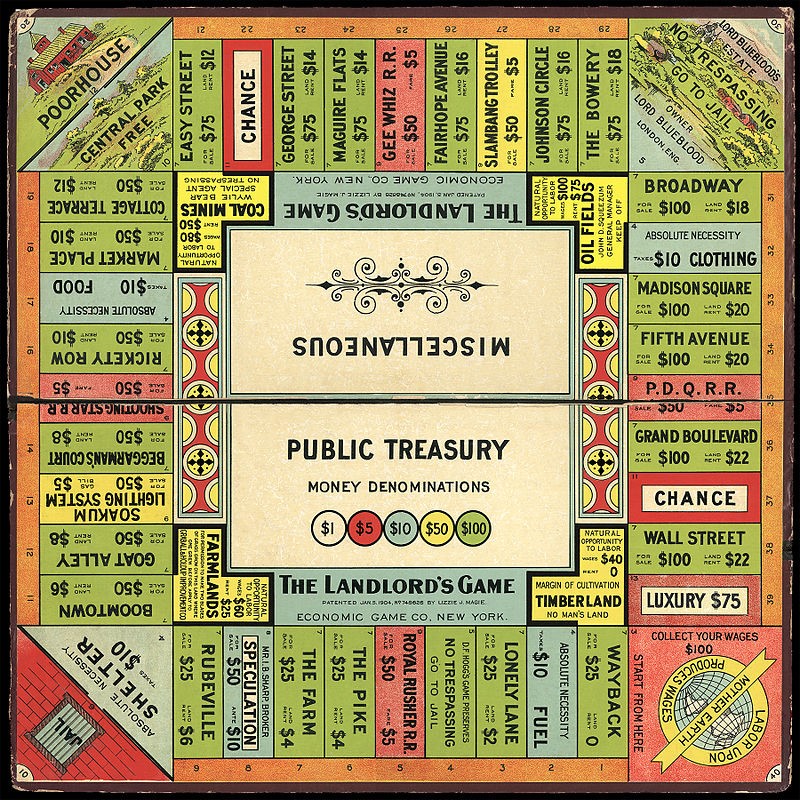
The next day I happened to catch the NPR show, “Throughline,” on the history of Monopoly. It was invented by Lizzie Magie, and patented in 1904 as “The Landlord Game,” to teach players “how rents enrich property owners and impoverish tenants” (Wikipedia). Today we seem to think of the game as a celebration of capitalism, but that was not Magie’s intent. She was a devotee of Henry George, a popular critic of free-market capitalism during the Gilded Age, and hoped playing the game would increase support for redistributive policys like George’s single tax on land. She also developed an alternate set of rules designed to show how a more just system would work (every player was rewarded when wealth increased in society).

I forwarded a version of this post to two economics teachers I know. Maybe they will have their students play Monopoly.

The Throughline episode also convinced me that Henry George probably deserves more attention than I give him in the winter term of US history.


Sources:

Mary Pilon, The Monopolists: Obession, Fury, and the Scandal Behind the World’s Favorite Game. 

"Do not Pass Go,”  Throughline, June 30, 2022.  Also interesting from the episode: During the Depression, Charles Darrow claimed to have invented the game in his basement (he was taught the rules by a friend) and sold it to Parker Brothers in 1934. Magie sued for patent infringement and was awarded a meger $500 for rights to the game. She mistakenly thought the Parker Brothers’ version would advance her anti-capitalist goals. In 1973, Ralph Anspach created a game he called “Anti-Monopoly” and was then sued by Parker Brothers.

“Ask Nick Anything,” Pitchfork Economics, July 5, 2022, @17:45-24:10

See also, on non-ergonomic systems:

Jason Zweig, “Disturbing New Facts About American Capitalism,” Wall Street Journal, March 3, 2017.  

“Winner take all," Ergodicity Economics, March 6, 2017.