Thursday, August 18, 2022

Teaching citizenship in a polarized society

And why treat dissenters properly? Why not just forget about them? Because the process of negotiating differences allows for social stability, and the alternative is civil war, whether in major or minor key (Danielle Allen, Talking to Strangers, 98).


In the past decade, the American electorate has become so polarized that scholars are beginning to wonder if democracy can survive here. We increasingly see politics as an ongoing battle between ideological opponents with no common interests. Political rivals are seen as illegitimate, opposed to the common good and threatening to our way of life. An election victory by the opposition is seen as endangering democracy or Western culture and that justifies norm-breaking responses. On the left, we might pack the Supreme Court; on the right, storm the Capitol.

At the root of this polarization is what Danielle Allen refers to in her primer on citizenship as “congealed distrust,” an insurmountable road block to solving “collective problems” because democratic problem-solving “depends on trustful talk among strangers.” (Monk; Allen, xiii; See also, Hess and McAvoy, xvi).

Schools, unfortunately, are contributing to the polarization of the American electorate. As Americans increasingly sort ourselves into ideologically homogenous communities, more and more schools fall into a category that two scholars of political education call “like-minded schools,” in which the vast majority of students hold similar political values. 

Studies show that "when we live and work among people who generally think as we do, our views tend to become more extreme and less tolerant," which "ferments extremism and causes demonization of legitimate political difference" (Hess and McAvoy, 26).

Parents (especially conservative ones) are increasingly worried about the politicization of schools. A 2011 survey found that half of Americans think social studies teachers use their classes as political platforms (Hess and McAvoy, 205). And that perception has surely deepened in recent years. Conservative fears of liberal indoctrination in schools are not altogether unfounded. FEC data show that 83 percent of political donations made by high school teachers went to the Democratic Party.

But teachers in like-minded schools can push against the intolerance that festers in ideologically homogeneous bubbles and do their part to depolarize our democracy.  I think it's their civic duty to at least try. 

Most teachers seem to agree. One survey found that 65 percent of teachers say they try to keep politics out of their classroom.

But that approach won’t solve the problem for teachers of politically charged subjects like history and civics. And politics is likely to sneak into the room no matter what subject you’re teaching.

Also, disengagement from politics is one of the negative consequences of polarization. According to a recent study by Reuters, 40 percent of Americans have stopped following the news, a higher rate of news-avoidance than almost every other democratic country. People, it seems, are tired of reading about problems that can’t be solved.  And the ones who disengage tend to be more moderate and less intolerant than the ones who don't.

All of America’s teachers should be asking whether there is a way to teach politics that diminishes rather than increases polarization. After all, today’s students are tomorrow’s voting citizens.

Conservatives might argue that a proper education for citizenship should focus on teaching students the nuts and bolts of America’s Democratic institutions and instilling patriotism and admiration for the handiwork of the founding fathers. Many liberals have concluded that a civics education should instill a passion for social justice and foster engagement in that system to improve it.

Danielle Allen’s work, elaborated on by Diana Hess and Paula McAvoy in their study of political education at America’s high schools, points in a different direction. A citizen, they argue, needs to understand the inevitability of sacrifice and its role in democracy, to distinguish between legitimate and illegitimate sacrifice, and to become capable of deliberating with fellow citizens who have opposing interests and different convictions about what constitutes “social justice” and the common good. This requires the skills of listening and understanding the views of people you disagree with, what civics advocate Moira Kelly referred to as “cognitive empathy” at a conference I attended.

They would likely agree with conservatives about the need for knowledge of the system, but perhaps not about instilling a particular notion of patriotism. They would agree with the liberals about engagement but would warn against imposing a particular vision of social justice.

This last point is essential. A proper education must be non-partisan. Teachers must refrain from imposing their own policy preferences on their students. This is the bedrock of teaching political subjects, according to Hess and McAvoy’s Political Classroom. This principle of neutrality applies, the authors argue, to any issue that is currently open—a matter of live controversy in our national politics. It does not apply to issues that are closed or settled, like slavery or women’s suffrage. (Hess and McAvoy address open and closed questions in Chapter 8).

Joel Kushner, a teacher profiled in the book, treats the issues of abortion and affirmative action as open questions, upon which he cannot impose his liberal preference, or even slant the readings in one direction. When, faced with a balanced selection of evidence, some of his liberal students end up agreeing with the conservative position in a court case on religion in the public sphere, Kushner, a liberal, is unfazed (114-115). Instead of persuading his students to adopt his own policy positions, Kushner wants to teach them about how democracy works and how to harmoniously and productively engage with fellow citizens and engage in collective decision-making.

Democracy and Sacrifice

One of the most important lessons students need to learn to become democratic citizens is that in spite of the individual freedom and sovereignty that democracies promise their citizens, we don’t always get our way even in a well-functioning democracy and are often asked to sacrifice our personal preferences and interests for the good of the whole, the survival of democracy, and the maintenance of peace. When our candidate loses the election, when we are drafted and sent into battle, and when policies favored by the majority disadvantage us or go against what we think is good, we are sacrificing something.

To illustrate the inevitability of sacrifice, Allen points to the Federal Reserve’s decision to raise interest rates in 2000 to tame inflation. That decision imposed a disproportionate sacrifice on some citizens when unemployment inevitably increased and wages flat-lined as a result. Others gained when investors reacted to the news of impending recession by bidding up the price of stocks.

Learning how to negotiate the losses one experiences at the hands of the public is fundamental to becoming a political actor, not only for minorities suffering political abuses, but for all citizens. (Allen, Talking to Strangers, 30)

Allen explores the difference between legitimate and illegitimate sacrifice. She begins her book with a discussion of the central failure of American democracy—the disproportionate and illegitimate sacrifices that African Americans like her have been forced to bear. Not until the triumphs of the Civil Rights Movement, she argues, did America become a true democracy.

How, she asks, can democratic citizens avoid imposing illegitimate or disproportionate sacrifice on fellow citizens and “generate enough political friendship” to “convert the distrust arising from political disappointment [and sacrifice] into trust” (Allen, 30)?

The interest rate hike might be seen as a legitimate sacrifice if it saved the majority of citizens from ruinous inflation. On the other hand, when stock-holders repeatedly win and wage workers repeatedly lose, congealed distrust is a likely result.

Societies can maintain or restore trust by recognizing and honoring citizens' sacrifice, Allen argues. We recognize the sacrifices of soldiers—the VA, Memorial Day, Veterans’ Day, Arlington National Cemetery, countless monuments all over the country, like the one in the photograph above. America has also begun to recognize the tremendous, usually illegitimate sacrifices made by African Americans throughout our history: the National Museum of African American History and Culture, the Martin Luther King Jr., Memorial on the National Mall, Bryan Stevenson’s National Memorial for Peace and Justice—and the monument depicted above. Other sorts of sacrifice quietly endured may be less costly, but are also important for the preservation of peace in a democratic system.

Can they be recognized and honored too? As interest rates rise again, is anyone acknowledging how low-wage-earners and the unemployed are likely to be sacrificed to save the rest of us from inflation? How do we deal with sacrifice aside from building monuments?

Political Friendship

Allen has developed, a theory of “political friendship” as a way of strengthening democracy by better managing sacrifice and building trust among citizens. Hess, and McAvoy argue for making that theory the basis of political education in grade school.

In a democracy, our collective fate depends on the maintenance of good will among strangers. Citizens must recognize this mutual dependence and treat these strangers, in a sense, as friends.

Friends often willingly restrain their own individual interests for the sake of what they see as a greater good: maintaining the friendship. Sometimes friends will even compete to make a sacrifice, as when they fight over who will pay the lunch tab.

Political friends are likely to have even greater competing interests and more diverse values and beliefs than intimate friends, but like intimate friends, they have an overriding interest in peaceful coexistence. Good citizens know that to keep the peace and nurture democracy, they must embrace the value of fairness and consider who is being made to sacrifice when particular policies are enacted. Citizens need to balance their own self-interest with the rights and well-being and interests of fellow citizens and not ask others to make illegitimate sacrifices. 

Like real friends who keep track of who paid for lunch the last time, citizens should always be asking what costs they are passing on to others, and whether the policies they favor are advancing the general good, or just the interests of a more powerful class of people (Allen, 119).

Elections and policy decisions can't be winner-take-all. Citizens must reject an attitude of rivalrous self-interest in which people compete for benefits with no concern for the impact on others or the collective.

Allen's concept of friendship is preferable to the currently fashionable notion in progressive circles of allyship because it acknowledges the fact that all political actors are entitled to and will inevitably pursue their own self-interest in the political world. And they need to be able think and reason for themselves. But if citizens pursue their own interests without restraint—without considering the impact on other citizens—distrust increases and democracy weakens. Thus, citizens can and will act in their own interests, but they should consider the harmonious relationship with "political friends" and important interest and move from rivalrous self-interest to what Allen calls "equitable self-interest."

Friends know that if we always act according to our own interests in an unrestrained fashion, our friendships will not last very long. Friendship teaches us when and where to moderate our interests for our own sake. In short, friendship solves the problem of rivalrous self-interest by converting it into equitable self-interest, where each friend moderates her own interest for the sake of preserving the relationship (Allen, 120).

Friends don’t push their advantages to the limit because the friendship, it turns out, is worth more than the sacrificed advantages. Citizens too, gain more from the peace that comes with treating fellow citizens fairly and from exercising forbearance—self-restraint in the exercise of power.

Teach political friendship

Danielle Allen was a contributor to the December 2019 “How to Stop a Civil War” issue of The Atlantic magazine, which featured articles about polarization and what might be done about it. One of the articles in particular stood out because of its focus on an excruciatingly earnest effort to overcome polarization by getting people from opposing political sides talking and listening to each other, developing cognitive empathy and practicing epistemic humility. The group was calling itself “Better Angels,” a phrase taken from Lincoln’s first inaugural—an earlier earnest but failed effort to prevent a civil war. Though they don't use the term as far as I know, they seem to be fostering something like Allen's notion of political friendship.

Their group is small compared to the size of the problem, but the effort is commendable.

Teachers should follow the example of Better Angels—who later changed their name to Braver Angels to reflect the courage needed to engage in that work—and do whatever they can to depolarize the future electorate, which is now in their hands. 

If they use Allen and The Political Classroom as guides, that would mean getting students to think about who is sacrificing as a result of a given policy, to recognize the difference between legitimate and illegitimate sacrifice and equitable and rivalrous self-interest, to see the connection between rivalrous self-interest and illegitimate sacrifice, and to appreciate the importance of trust among citizens in a healthy democracy. They might also examine how communities honor some sacrifices and ignore others. 

The task is particularly challenging for teachers like me who teach in like-minded schools, where students rarely encounter people with opposing viewpoints and are likely to think of them in abstract terms, as unreasonable, ignorant, or acting in bad faith.

A case study by Hess and McAvoy of Joel Kushner’s classes—at a school where 94 percent of students identify as Democrats—offers some suggestions for how to overcome those challenges. 

Kushner’s curriculum pushes against that attitude by assigning readings that make persuasive arguments on different sides of policy issues and encouraging students to listen and understand (cognitive empathy) before criticizing and rebutting. He plays devil's advocate when necessary, but  thinks its better for students to encounter actual people who disagree with them. To make that happen, he invites guest speakers who hold views uncommon in his school community. For example, he invited an anti-abortion activist to speak to his mostly pro-choice students.

And significant differences often arise even within a group of liberal students.  Kushner shapes "discussion questions so students will naturally disagree" (Hess and McAvoy, 117). When they do, he doesn’t stop emotional exchanges. In a discussion of Affirmative Action, a Black girl defended the policy by bringing in her personal experiences of racism, which in the context of a court case they had studied, seemed to be irrelevant to the question at hand. Rather than steering the conversation away from her emotionally charged comments toward more relevant information in the assigned readings, Kushner let the discussion unfold from there without intervention.

Kushner’s restraint in that case is supported by Allen’s comments on the role of emotion in politics:

It is just as impossible to exclude emotion from politics as to ban interest.... As soon as one begins to take trust and distrust seriously, and to ask how trust can be generated, one realizes that reason, interest, and emotion cannot be disentangled (Allen, 56).
Expression of emotion between citizens humanizes us and is an essential ingredient in the generation of trust. “Sociability, not rationality, produces agreement” Allen writes, and only in emotionally honest conversation do citizens find out “what their fellow citizens are worth to them” (Allen, 96).

Our political “disagreements have as much to do with reciprocity and issues of mutual esteem as with the substantive issue under discussion.” Trust among citizens is fragile and tenuous, given our geographic separation and conflicting interest and values, and so we “must be committed to [trust generation] in perpetuity” (Allen, 97).

The emotion that occurs naturally in political discussions is an aspect of the authenticity that Kushner values in the teaching of politics. It is preferable for students to encounter authentic political viewpoints expressed by those who hold them rather than listening to him play the devil's advocate. The devil's advocate removes the personal from the political. When students encounter real people holding real views, not just intellectual abstractions, it helps them see those people as having moral worth. To be good citizens they need to learn how to talk about differences in ways that preserve relationships and respect. They need practice responding to such others in a way that promotes goodwill, respect, and humility. (Hess and McAvoy, 117, 127).

Humanizing political rivals is important, but so is understanding them—developing "cognitive empathy," as Moira Kelly put it. It helps if you keep an open mind.  Hess and McAvoy say that citizens should always be asking themselves: “could I be wrong?” Humanities teachers put a lot of emphasis on critical reading of documents, and training students to look for hidden meanings and unconscious bias in the thoughts of others. But first we should be teaching them to be aware of their own unconscious drives and hidden biases and to develop "epistemic humility." An effective visual tool is the “cognitive bias codex.” When students read about some of these they should recognize how they are just as prone to faulty thinking as people they disagree with.

Schools would make a significant contribution to saving American democracy if they would produce a new generation of citizens with more cognitive empathy, epistemic humility, an understanding of what citizens owe each other, and a determination to foster trust among their fellow citizens. It’s not an immediate solution, and it may not work as intended, but it would be inexcusable not to make the effort.


Notes and sources

On polarization, see Yasha Monk, "The Doom Spiral of Pernicious Polarization," The Atlantic, May 21, 2022.  For a right justification of norm-breaking, see Michael Anton, “The Flight 93 Election,” Claremont Review of Books, originally published under the pseudonym, Publius Decius Mus on Sept. 6, 2019; for a Left-justification, Corey Robin, "Democracy is Norm Erosion," Jacobin, Jan. 29, 2018.

For an example of the perception that schools indoctrinate students in progressive or liberal values, see Ethan King, Letter to the Editor, Caledonian Record, Sept. 2, 2021.

FEC data on teachers and others' political contributions is listed in numerous places.  This one shows high school teachers as 95% Democrat in a graph at the top; below it gives the 83% number.

Amanda Ripley, “I stopped reading the news,” Washington Post, July 8, 2022.

Moira Kelly, Executive Director and President of Explo and Associate Producer for the Commission on Presidential Debates spoke about cognitive empathy in her talk, “Promoting Cognitive Empathy in a Polarized Society,” at the AISNE Annual Diversity Conference, Lexington, Mass., Nov. 2016. Kelly argues that citizenship requires cognitive empathy rather than emotional empathy, which can be counter productive. On this negative potential for emotional empathy, see Jodi Clarke, “Cognitive vs. Emotional Empathy” at Verywellmind.com: “When our vicarious emotional arousal becomes too great, it can actually get in the way of us being compassionate and empathizing. Feeling emotionally dysregulated can become overwhelming and result in feeling burned out. Ultimately, this leaves you not wanting to practice empathy because it's too painful to be there for someone else. Our ability to practice emotional empathy becomes a threat to our own well-being when it results in feelings of isolation, being misunderstood, and feeling inauthentic.”  Kelly also argued that the best method for teaching cognitive empathy is the Harkness Method, pioneered at Phillips Exeter Academy.

On “Forebearance,” see Steven Levitsky and Daniel Ziblatt, How Democracies Die, (2018).

The “How to Stop a Civil War,” Atlantic issue was December, 2019. See, esp. Andrew Ferguson, “Can this Marriage be Saved?” 86-90.  See also, the Podcast featuring Danielle Allen discussing the issue. A  Single copy of the December 2019 is available on Amazon.

Braver Angels website

Upcoming related posts on this blog (maybe--school year starts soon): How Joel Kushner seeks to foster trust among students in his racially and socioeconomically diverse classroom; My reading notes: the source of “Political Friendship”; You could be wrong; Teaching citizenship vs. teaching social justice.

Tuesday, July 26, 2022

Teaching about economic inequality

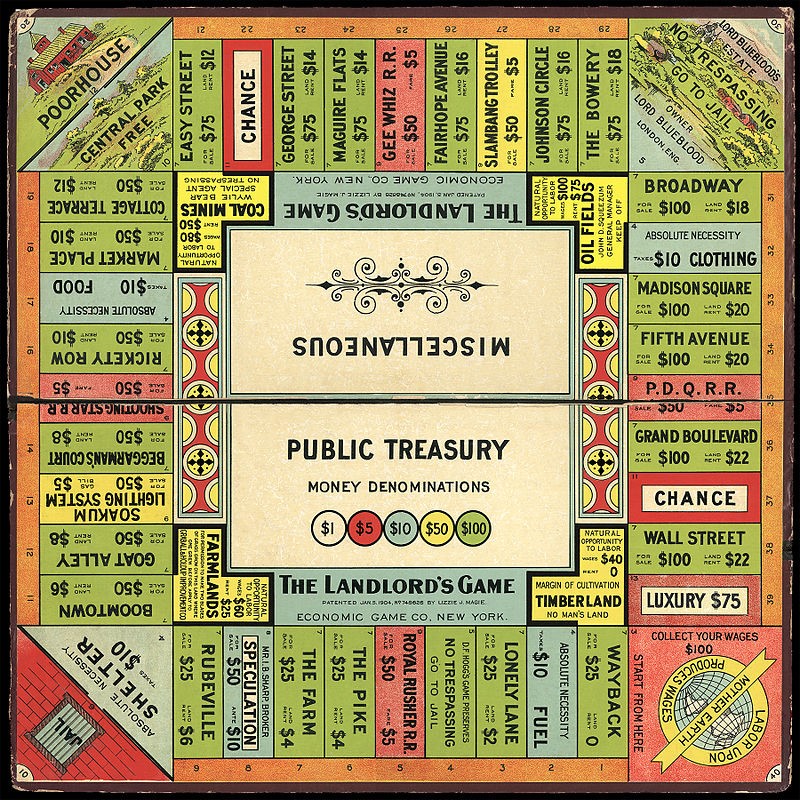
I was listening to a podcast called Pitchfork Economics, when Thomas Picketty’s theory about the cause of inequality in capitalist economies came up (Wikipedia: “the rate of capital return in developed countries is persistently greater than the rate of economic growth, and that this will cause wealth inequality to increase in the future”). It’s a valid thesis, the podcasters said, but a better explanation can be found by playing the game of Monopoly, which was designed to teach kids about capitalism and how it works. The outcome of every game is that one person ends up with all the money and everyone else ends bankrupt.

Just a game you say? Maybe not.

According to Nick Hanauer, the host of the podcast, Monopoly and capitalism are both “non-ergotic systems,” governed by path-dependence (past events or decisions constrain later events or decisions), luck, and the compounding of advantages and disadvantages.

Not all games are non-ergotic, they noted.  Two equally skilled tic tac toe contestants will always end in a tie. Two good checkers players will end up winning an equal number of games over time. Those games are ergotic.

One difference between Monopoly and capitalism, Hanauer says: Monopoly is more meritocratic since every player begins with an equal amount of money.  At the start of adult life in American capitalism, there is a huge gulf between the best and worst off of us.  To replicate that system in the game, one player would start with $1.5 million, they estimate, another would start off in debt.  Most everyone else would be arranged above and below the median for 20-year olds (it's $13,900 for Americans under 35, according to one source, for for 20-year-olds, who knows?).  

Also, in actually-existing capitalism, once you get enough money you can spend it to change the rules in your favor.

The next day I happened to catch the NPR show, “Throughline,” on the history of Monopoly. It was invented by Lizzie Magie, and patented in 1904 as “The Landlord Game,” to teach players “how rents enrich property owners and impoverish tenants” (Wikipedia). Today we seem to think of the game as a celebration of capitalism, but that was not Magie’s intent. She was a devotee of Henry George, a popular critic of free-market capitalism during the Gilded Age, and hoped playing the game would increase support for redistributive policys like George’s single tax on land. She also developed an alternate set of rules designed to show how a more just system would work (every player was rewarded when wealth increased in society).

I forwarded a version of this post to two economics teachers I know. Maybe they will have their students play Monopoly.

The Throughline episode also convinced me that Henry George probably deserves more attention than I give him in the winter term of US history.


Sources:

Mary Pilon, The Monopolists: Obession, Fury, and the Scandal Behind the World’s Favorite Game. 

"Do not Pass Go,”  Throughline, June 30, 2022.  Also interesting from the episode: During the Depression, Charles Darrow claimed to have invented the game in his basement (he was taught the rules by a friend) and sold it to Parker Brothers in 1934. Magie sued for patent infringement and was awarded a meger $500 for rights to the game. She mistakenly thought the Parker Brothers’ version would advance her anti-capitalist goals. In 1973, Ralph Anspach created a game he called “Anti-Monopoly” and was then sued by Parker Brothers.

“Ask Nick Anything,” Pitchfork Economics, July 5, 2022, @17:45-24:10

See also, on non-ergonomic systems:

Jason Zweig, “Disturbing New Facts About American Capitalism,” Wall Street Journal, March 3, 2017.  

“Winner take all," Ergodicity Economics, March 6, 2017.

Monday, January 3, 2022

Anti-authoritarianism is anti-racist

“Capitol Jan 6” by Blink O’fanaye
A scene from Jan. 6.

Over the past quarter century, the world has seen a disturbing revival of authoritarianism. According to the cover of the December Atlantic, in the struggle between despotism and democracy, "the bad guys are winning." A Times pundit asks whether 2024 will be the year democracy dies in the US.  Freedom House, in a colossal understatement, says we are in the “longest democratic slump of its kind” in the 40 years they’ve been monitoring democracy.

The greatest threat comes from right-wing populists, like the mob that stormed the capital, or the dictators who hold actual power in Europe. Yet illiberal behavior is also showing up in liberal institutions controlled by the left. While that behavior doesn’t pose as direct a threat to the survival of democracy, it threatens to seriously hamper the fight against authoritarianism.

The case of Democratic data analyst David Shor is instructive.  In a tweet, Shor suggested that outbreaks of arson, looting and violence during the George Floyd protests could hurt the party’s chances of winning in November. He included a link to a scholarly article by a Black Princeton professor to support the claim. After a left-wing Twitter mob and some co-workers attacked Shor for “minimizing Black grief and rage” (among other things) and flooded his employer, Civis Analytics, with demands he be fired, Shor apologized but was fired anyway.

What’s particularly troubling about this case from an anti-authoritarian point of view is that Shor, a self-proclaimed socialist, is one of the most insightful Democratic strategists working for the party. A “data guru,” who pioneered new data analysis methods that proved “spookily accurate” in the 2012 election, according to liberal pundits Erik Levitz  and Ezra Klein, his firing is a painful example of how purging dissenters hampers the good guys in their effort to wrest power from authoritarians.

Shor is just one incident, but such examples abound on the left—firings or forced resignations, investigations, demotions, suspensions, de-platforming, book bans, black-listing.

(Of course, cancellation is also common on the authoritarian right in even more consequential ways. Republicans who defy Trump are driven out of Congress; death threats are lodged against Democratic and Republican public officials for doing their jobs.)

Matt Yglesias summed up the principle behind Shor’s firing. According to the logic of anti-racism as it’s now practiced, he said, “it’s categorically wrong for a person—or at least a white person—to criticize on tactical or other grounds anything being done in the name of racial justice.”

That, he continues, is “going to be a big problem for progressive politics if it becomes impossible to have frank conversations around the tactics and substance of race-related issues.”

Yglesias wrote about Shor’s firing in the aftermath of another controversy, over an open letter in Harper’s Magazine, signed by 153 prominent intellectuals defending free speech against the constriction of debate, leftist censoriousness, “intolerance of opposing views, a vogue for public shaming and ostracism, and the tendency to dissolve complex policy issues in a blinding moral certainty.”  Emily VanDerWerff, a trans-gender co-worker, tweeted that Yglesias, by signing the letter, made her “feel less safe at Vox,” where they both worked.  Although the signers included left-wing stalwarts like Noam Chomsky, African Americans like the historian Nell Irving Painter, and at least one trans woman, Deirdre Nansen McCloskey, VanDerWerff objected to Yglesias signing the letter because, she claimed, it had also been signed by “several prominent anti-trans voices” (presumably including J.K. Rowling). She also claimed that it included anti-trans “dog whistles,” though she never identified them. VanDerWerff tweeted her critique and then became the object herself of a hostile Twitter mob, illustrating that cancellation comes from every direction.

Yglesias left Vox a few months later and established a new blog at Substack, citing a desire to “be a fiercely independent and at times contentious voice.”  In doing so, he joined a group of prominent journalists fleeing established liberal or centrist publications, where they felt their perspectives were no longer welcome, for their own blogging or podcasting platforms: Glenn Greenwald and Zaid Jilani left The Intercept, Bari Weiss and Nellie Bowles The Times, Tara Henley, the Canadian Broadcasting Corporation, Katie Herzog The Stranger, and Andrew Sullivan New York Magazine.

Asked if the conflict over the Harper’s letter had anything to do with his departure from Vox, Yglesias said: “Something we’ve seen in a lot of organizations is increasing sensitivity about language and what people say… It’s a damaging trend in the media in particular because it is an industry that’s about ideas, and if you treat disagreement as a source of harm or personal safety, then it’s very challenging to do good work.” 

Yglesias and Shor landed on their feet. When high-profile or wealthy individuals are canceled, it can bolster their careers. But dissenters who lack a big following are not likely to fare so well. And even more damaging to institutions like Vox and Civis Analytics than losing prominent individuals like Shor and Yglesias is the chilling of dissent among the rank and file who remain, and who can’t afford to lose their jobs.

The New York Times, which has itself been at the center of a number of such controversies, has even assigned a reporter to cover the cancellation beat. Michael Powell has written about the illiberal behavior of liberal institutions and individuals at MIT, Smith College, the ACLU, the Democratic Socialists of America, the University of North Texas, epidemiologists, and elite private schools.

Asked in an interview whether such incidents added up to a significant trend that we should be worried about, Powell said they “almost certainly” did. He said that of the 15 tenured professors he spoke with at Smith College, none of them, with “perhaps one exception,” “disputed that there was an illiberal stream running through liberal higher education.” None were willing to go on the record, and some of them even denounced the sentiments they had expressed to Powell during a subsequent faculty meeting, apparently in a craven effort to cover their tracks.

In their “Scholars Under Fire” database of actions against university professors “for engaging in constitutionally protected forms of speech,” FIRE (the Foundation for Individual Rights in Education) lists 237 such incidents coming “from the right” and 321 “from the left” since 2015. 

Anne Applebaum spoke with some of the academics who have been targeted for violating new “social codes” for an article in the Atlantic Even worse than any formal punishments, it seems, is the social ostracism that follows such charges. Once an accusation has been lodged, she writes:

The phone stops ringing. People stop talking to you. You become toxic. "I have in my department dozens of colleagues—I think I have spoken to zero of them in the past year," one academic told me. … "I wake up every morning afraid to teach," [another said]… The university campus that he once loved has become a hazardous jungle, full of traps.
Illiberalism on the left is supported by theories that dismiss as based in patriarchy and white supremacy things like open debate, reason, objectivity, and democratic process—essentially the bedrock principles of liberal democracy. In an earlier post, I mentioned Ibram X. Kendi’s call to give an unelected committee made up of “experts on race” the power to invalidate any law enacted by any democratically elected governmental body if it is judged to increase racial disparities.

I also wrote about a popular diversity training method that identifies European Enlightenment culture as white and inherently racist.

I hesitate to wade into the contentious debate over critical race theory here—or to seem to side with conservatives who have used it to discredit all anti-racist efforts, but there is no denying that CRT sees rationalism and free speech as tools of oppression rather than liberation. In their brief, sympathetic introduction to the theory, Richard Delgado and Jean Stefancic say that “Critical race theory questions the very foundations of the liberal order, including equality theory, legal reasoning, Enlightenment rationalism, and neutral principles of constitutional law” (Delgado and Stefancic, 3).

The theory itself is not actually taught in K-12 schools, but it’s dishonest to suggest that CRT and other post-modern theories have no presence in America’s grade schools when they are used extensively in education programs that train teachers and administrators.  Delgado and Stefancic celebrate this fact, noting that “many scholars in the field of education consider themselves critical race theorists” (7).

Opinion polls have also shown that the rise of illiberal sentiment is not confined to right-leaning voters. In 2014, when President Obama’s legislative agenda was being stymied by a Republican Congress, 30 percent of Democrats said they were in favor of a president closing Congress and governing without it “when the country is facing very difficult times”—something even Lincoln didn’t do during the Civil War. “A 2019 survey by political scientists at Louisiana State University and the University of Maryland found that around 18 percent of Democrats and 13 percent of Republicans thought violence would be justified if the opposing party won the 2020 election.”

A Cato Institute survey found that while 36 percent of “strong conservatives” say they would support the firing of employees because they donated to Joe Biden’s campaign in 2020, 50 percent of strong liberals said the same about employees who contributed to Trump’s campaign. The survey also found that the percentage of Americans who say they self-censor to avoid offense has risen from 58 percent in 2017 to 62 percent in 2020. Those 2020 numbers were higher for conservatives at 77 percent than for liberals, at 52 percent.

I don’t think you can save liberal democracy by embracing a less bad version of authoritarianism. Winning strategies to save democracy and defeat racism are less likely to emerge from dogmatic acceptance of untested theories or the silencing of dissenters among the "good guys" than from a reasoned discussion of competing ideas and consideration of the best available data—the very methods of the enlightened liberalism we are trying to save.

Institutions of higher education play an important role in such efforts because that is where citizens learn those methods and get practice using them.

And I can think of no school better suited to that role than one that has placed a seminar table in every classroom.

NOTES & SOURCES

(Go here for a guide, with links, to my series on teaching anti-racism)

On the decline of liberal values.

Karen Stenner and Jessica Stern, “How to Live With Authoritarians,” Foreign Policy, February 11, 2021.

German Feierherd, Noam Lupu, and Susan Stokes, “A significant minority of Americans say they could support a military takeover of the U.S. government,” Washington Post, February 16, 2018.

Emily Ekins “Poll: 62% of Americans Say They Have Political Views They’re Afraid to Share,” Cato Institute, July 22, 2020. 

Sally Satel, “The Experts Somehow Overlooked Authoritarians on the Left,” The Atlantic, Sept. 25, 2021. 

Thomas Edsall, "'The Whole of Liberal Democracy Is in Grave Danger at This Moment,’" New York Times, July 22, 2020. Edsall reviews theories about the relative strength of authoritarianism on the right and left. "Disputes over differences in judgment, character and moral values between liberals and conservatives are among the most fraught topics in political psychology," he writes. Edsall seems to come down on the side of Karen Stenner, who is quoted in the title of the piece. She added: "But the fault lies with authoritarians on both the right and the left, and the solution is in the hands of non-authoritarians on both sides."

On the threat from the right.

Why put so much effort into criticizing illiberalism on the left, when what’s happening on the right is so much worse? My answer to this question is simple. Democrats can’t win elections without attracting a certain number of working class white voters and left-wing illiberalism seems to be driving voters away from the Democratic Party.

Right-wing authoritarianism poses the greater threat to democracy. The January Atlantic Magazine catalogues efforts by Trump supporters to gain control over electoral processes in the states so they can assure Trump is restored to the presidency in 2025 regardless of the vote totals in November 2024. The Atlantic puts it this way: “January 6 was practice. Donald Trump’s GOP is much better positioned to subvert the next election.” 

But for all of that, it’s important to remember that even without stealing elections, Republicans are fairly successful at getting Americans to vote for them. Trump got 74 million votes in 2020—including more ethnic minority votes than he got in 2016. Republicans control of 60 percent of state legislative chambers, 67 percent of the Supreme Court, which was the final arbiter in the 2000 presidential election, and the odds are good that thanks to their success in gerrymandering and voter suppression, they will take over Congress in the 2022 midterm election. Democrats will have to win the popular vote by about 3 percent to carry the electoral college and keep the presidency in 2024. Biden’s low approval record suggests this will be an uphill battle.

In their 2012 book, It's Even Worse Than It Looks: How the American Constitutional System Collided With the New Politics of Extremism Thomas E. Mann and Norman J. Ornstein used the term “asymmetric polarization,” to illustrate how the right was more responsible for the decline of America’s civic culture.

Michael Powell’s most recent piece focused on the impact on Texas public schools of a conservative anti-CRT law, which prohibits teachers from eliciting feelings of “discomfort, guilt, or anguish” or using the Times’ 1619 Project in their classes. In his interview with Yasha Mounk, Powell characterized what he saw in Texas as “a funhouse mirror of what you see on the left” and concluded that “it’s a bad place for freedom of inquiry right now.”

Spencer Bokat-Lindell, “Will 2024 Be the Year American Democracy Dies?” New York Times, Sept. 30, 2021 

Anne Applebaum, Twilight of Democracy: The Seductive Lure of Authoritarianism (2020). On the last pages of the book, Applebaum, an anti-Trump conservative, calls for "new coalitions," presumably among anti-authoritarians of the right and left.  In the Twilight and her December cover story in the Atlantic, Applebaum focuses mainly on anti-liberalism on the right, but an earlier Atlantic piece attacked left-wing illiberal behavior. The December piece also lamented that the American left is so busy engaging in circular firing squads that it is failing to counter the rise of authoritarianism abroad.

Focused on America’s own bitter problems, they [Americans on the left] no longer believe America has anything to offer the rest of the world: Although the Hong Kong prodemocracy protesters waving American flags believe many of the same things we believe, their requests for American support in 2019 did not elicit a significant wave of youthful activism in the United States, not even something comparable to the anti-apartheid movement of the 1980s.
Incorrectly identifying the promotion of democracy around the world with “forever wars,” they fail to understand the brutality of the zero-sum competition now unfolding in front of us. Nature abhors a vacuum, and so does geopolitics. If America removes the promotion of democracy from its foreign policy, if America ceases to interest itself in the fate of other democracies and democratic movements, then autocracies will quickly take our place as sources of influence, funding, and ideas.
On safetyism and “cancel culture”

On VanDerWerff’s charge that Yglesias made her feel unsafe by signing the Harper’s letter, see Berny Belvedere, “Harper’s scarlet letter: Matthew Yglesias, free speech, and cancel culture,” Arc Digital, July 12, 2020. “The suggestion that taking the contrary position literally endangers those on the opposing side has a clinching effect—the debate can’t continue. It is shut down because of safety concerns,” Belvedere wrote. Claims that the expression of certain points of view endanger the safety of some people are widespread on the left, as when some New York Times reporters claimed their safety was endangered by the printing of a Tom Cotton editorial during the George Floyd protests in 2020. Belvedere also presents an example of how the helpful concept of political “dog whistles” can be used in bad faith to claim the ill-intent of any viewpoint. There is also a definition of “cancel culture,” which would suggest that, although Yglesias wasn’t forced to resign, he might still be considered a victim of a cancellation. It is a useful definition, worth quoting at length:
I think we see a targeting as a cancellation when the person who is in the crosshairs is there for views we think should continue to be seen as discourse legitimate. Since there is considerable difference of opinion regarding what our discourse parameters should be, this naturally leads to wildly divergent applications of “cancel culture”—it leads to people substantially disagreeing about whether a particular targeting counts as a cancellation or not.

Blake Neff, a longtime senior writer for Tucker Carlson’s show on Fox News, was fired when his relentlessly racist and sexist online comments under a pseudonym came to light. Is this a cancellation? This one isn’t hard at all. It’s manifestly not [because not discourse legitimate]….

If one thinks the views in question are seriously inappropriate, the offending person’s termination won’t be seen as a “cancellation” but as a righteous application of discourse accountability. It follows that, on some occasions, our “cancel culture totally exists!/cancel culture is totally nonexistent!” back-and-forths are really just disguised ways of saying “I think this view should continue to be debated!/I think this view should not be up for discussion!”

A harder thing to pin down is when exactly reputational damage, rather than employment status, counts as “cancel culture.”

I suggest not conceiving of cancel culture as primarily having to do with outcomes. This is tough when the name itself, “cancel,” is a success term. If someone has not actually been canceled, then how can their targeting be called a cancellation? It makes intuitive sense to require a cancellation to involve a genuine canceling.

But I want to move away from this understanding of it because, often times, the outcomes are predicated on arbitrary factors like whether the target is independently wealthy, or how amenable their boss is to outspokenness, or how fearful their university is of lawsuits, or any number of other luck-based factors that take us away from the supposedly inappropriate actions.

Saturday, January 1, 2022

Viewpoint diversity supports antiracism

Viewpoint diversity at the Harkness table

“The peculiar evil of silencing the expression of an opinion is that it is robbing the human race, posterity as well as the existing generation, those who dissent from the opinion, still more than those who hold it. If the opinion is right, they are deprived of the opportunity of exchanging error for truth; if wrong, they lose, what is almost as great a benefit, the clearer perception and livelier impression of truth produced by its collision with error.” John Stuart Mill, On Liberty, Chapter 2

A great strength of the school where I teach is the racial and ethnic diversity of its student body. It's a strength that is cultivated by the admissions department, and rightly celebrated and boasted about in our promotional literature.  Less attention is paid to diversity of viewpoint. 

In my politics class, I am lucky if I have one student out of 12 who identifies as conservative, and most of them are quick to say that they are only conservative on economic issues.  I can only recall one outspoken cultural conservative in recent years and she paid a social price for voicing her opinion—a cost few adolescents are willing to bear. Her experience illustrates why conservatives on campus, among both students and faculty, tend to keep their opinions to themselves. 

But their silence shrinks the political discourse on campus and therefore diminishes the political education that our students are getting; it doesn’t prepare them for the political milieu of the country they live in. The American electorate does not resemble the political climate in schools like Exeter.  And the stifling of dissent and the establishment of ideological monocultures contribute to the nation’s political polarization, which threatens the very survival of democracy.

Students who adhere to a group’s majority viewpoint rarely have to defend their position. Meanwhile, dissenters go underground with like-minded peers into an echo-chamber within an echo-chamber. Or they might rebel. The LA Times tells the story of Trump aide Stephen Miller, who rebelled against what he saw as a “campus indoctrination machine” at Samohi High School in “The People’s Republic of Santa Monica.” In doing so, he mastered the tactics of lib-baiting that catapult him to prominence as a Trump troll. Samohi classmate Kesha Ram, a Vermont state representative who campaigned for Bernie Sanders in 2020, told the Times “I think it helped him to be a stronger advocate for his position to go to a high school like ours.”

Exeter has not produced any Stephen Millers as far as I know, but I’ve often thought that our outspoken conservative students, who have to frequently explain their position, become much better at defending their ideas and values than liberal students do. It’s almost like we've created a boot camp for conservatives.

It’s impossible to know how many public schools have become liberal or conservative echo chambers. The New York Times reports that conservative Christian schools are experiencing an enrollment boom as parents pull their children out of schools they perceive as engaging in left-wing indoctrination.  Meanwhile, parents told Times reporter Michael Powell that elite private schools are imposing a “suffocating and destructive” anti-racist and diversity “groupthink” on their children.  Critics perceive a similar environment at the nation’s elite colleges. Yale English Professor William Deresiewicz says that elite universities,
don’t have “different voices” on campus, as these institutions like to boast; you have different bodies, speaking with the same voice. That, by the way, is why liberal students (and liberals in general) are so bad at defending their own positions. They never have to, so they never learn to. That is also why it tends to be so easy for conservatives to goad them into incoherent anger.

This comment brought to mind Malcolm Nance’s cringe-inducing defense of critical race theory against Ben Shapiro’s scathing attack. Anyone looking for a persuasive defense of CRT would not find it here.


Nance’s performance suggests he agrees with the Williams College professor who denigrated “intellectual debate” because it “comes from a world in which white men dominated.”  Of course the Bill Maher show is not the best place to work out our differences. Cable TV and social media have polarized the electorate to a point where democracy can’t seem to function. But if institutions of higher education also increase polarization, we are in deep trouble. Surely Williams College and Phillips Exeter Academy are places where intellectual deliberation (a word I prefer to “debate”) between people with different viewpoints can take place and where some common ground might be found.

To make this happen, institutions of higher education need to return to their core mission of pursuing truth and this requires making it safe to dissent from majority viewpoints within, of course, the bounds of civility (see note on Palfrey, below).

Not only does exposure to strong opposing arguments teach people to defend their views, it also fosters understanding, empathy and tolerance of fellow citizens who think differently while helping us to refine and improve our own thinking. On the other hand, research has shown that those who live and work among people who agree with them become more extreme in their views and less tolerant (Hess and McAvoy, 26).

Exeter’s dearth of conservative voices goes back as long as I’ve been there—24 years. But anti-racism threatens to silence another large group of voices and narrow the political discourse even further. Lots of people who tend to vote for Democrats and support most items on the liberal or even leftist agenda do not subscribe to the entire anti-racist/diversity orthodoxy. They may emphasize class over race, or have reservations about “identity politics” and the post-modernist theories that seem to be behind much of that orthodoxy.

This group spans a wide range of opinion on the left, ranging from moderate liberals to Jacobin-reading socialists, and includes people of all races and genders—like the 87 percent of Hispanic or Latino Americans who have heard about the new term “Latinx” but decline to use it.  Or the 40 percent who say they are offended by it.

Conflicts among liberals in school environments are mostly hidden from public view. Michael Powell has had trouble getting teachers, professors, administrators and even parents to go on the record criticizing the anti-racist orthodoxy at elite schools and universities. A white mother of a private school student told Powell that speaking out was “laden with risk. ‘People and companies are petrified of being labeled racists,’ she said.” Parents are also loath to jeopardize their children’s position at selective schools. 

If knowledge-producing institutions offer fewer opportunities for truth to collide with error, our view of reality will become hazier and our ability to solve or mitigate problems—including racism—will deteriorate.  

The dynamics that reduce dissent on campus are mostly hidden because of a usually-appropriate desire to protect the privacy of students and employees.  Political parties and the media are less constrained by privacy concerns, so the dynamics of epistemic closure are more apparent there.  My next blog post will explore some of these dynamics, which may offer insights into what is happening in less-public venues.


NOTES AND QUOTES

(Go here for a guide, with links, to the essays in my series on teaching anti-racism)

William Deresiewicz, “On Political Correctness, Power, class, and the new campus religion,” The American Scholar, Nov. 2, 2021.

John Palfrey, Safe Spaces, Brave Spaces: Diversity and Free Expression in Education (2017).  Former Phillips Andover Academy Principal Palfrey makes sensible suggestions for balancing the need to make institutions welcoming for people from diverse backgrounds with the values of free speech. .

Paula McAvoy and Diana Hess, The Political Classroom: Evidence and Ethics in Democratic Education, (2015).

Hannah Natanson, “A white teacher taught white students about white privilege. It cost him his job.” Washington Post, Dec. 6, 2021.  Though it ends with the firing of a liberal teacher from what seems to be a conservative echo-chamber, the beginning of this article reads like a case study in why it is important to provide viewpoint diversity in a high school. Conservative students said this about their experience in a classroom with Matthew Hawn, a teacher who exposed them to a liberal point of view:

“It made me think, from that point on, that I can change my mind on issues,” said Thomas, who is majoring in history at East Tennessee State University because Hawn’s class inspired a love for the subject.

Before meeting Hawn, Thomas said, “I don’t know if I could have been the type of guy to listen to other people’s arguments, or see from their point of view.”
Sadly, Hawn was fired after being accused of imposing his political views on his students.

Ted Balaker, “The Unseen Side of ‘Cancel Culture,’” Persuasion, Dec 17, 2021.  Filmmaker Ted Balaker writes that “the threat to free expression goes well beyond high-profile cancellations,’” and more often happens in subtle ways in which the diversity and anti-racist agenda stifles freedom of expression, if not of thought. He concludes:
Students tell me they engage in a kind of “pre-canceling,” which includes scrubbing their social media feeds of anything a grad school or future employer might find problematic. The Foundation for Individual Rights in Education (FIRE) discovered that many students fear their college would punish them for saying something deemed “offensive,” and that fear contributes to widespread self-censorship among students. Young people are most likely to shy away from topics like race and sex, topics that lie at the center of some of our most intractable problems. How can we improve society if we’re afraid to discuss important issues openly?

In short, cancel culture’s biggest blow doesn’t strike Dave Chappelle, or any individual person. It strikes what so many defenders and deniers of cancel culture care about so much—progress. And that strikes us all.

Richard Delgado and Jean Stefancic, "B. 'Internal' Criticism," in Critical Race Theory: An Introduction, 3d ed. (2017), 104-108. Not only do all Democratic-Party-voting people not agree with each other on every point, even the practitioners of critical race theory have their (substantial) differences. As a strategy for advancing racial justice, CRT would seem to need lots of open, frank discussion among people of good will before adopting it as a totalizing system of thought.

On "Latinx": This author, writing on the NBC News website, explains why Americans with roots in Latin America do not prefer the term Latinx.  Use of the term by Democratic politicians is driving Latino voters away from the party according to Politico.  And the Atlantic reports that Democratic politicians are increasingly declining to use the term.  

Julian Sanchez, "Frum, Cocktail Parties, and the Threat of Doubt," Juliansanchez.com, March 26th, 2010.  Libertarian blogger Julian Sanchez appropriated the term "epistemic closure" from philosophy to describe what was happening within movement conservatism back in 2010.

One of the more striking features of the contemporary conservative movement is the extent to which it has been moving toward epistemic closure. Reality is defined by a multimedia array of interconnected and cross promoting conservative blogs, radio programs, magazines, and of course, Fox News. Whatever conflicts with that reality can be dismissed out of hand because it comes from the liberal media, and is therefore ipso facto not to be trusted. (How do you know they’re liberal? Well, they disagree with the conservative media!) This epistemic closure can be a source of solidarity and energy, but it also renders the conservative media ecosystem fragile.Think of the complete panic China’s rulers feel about any breaks in their Internet firewall: The more successfully external sources of information have been excluded to date, the more unpredictable the effects of a breach become. Internal criticism is then especially problematic, because it threatens the hermetic seal. It’s not just that any particular criticism might have to be taken seriously coming from a fellow conservative. Rather, it’s that anything that breaks down the tacit equivalence between “critic of conservatives and “wicked liberal smear artist” undermines the effectiveness of the entire information filter. If disagreement is not in itself evidence of malign intent or moral degeneracy, people start feeling an obligation to engage it sincerely—maybe even when it comes from the New York Times. And there is nothing more potentially fatal to the momentum of an insurgency fueled by anger than a conversation. A more intellectually secure conservatism would welcome this, because it wouldn’t need to define itself primarily in terms of its rejection of an alien enemy....

It’s fundamentally a symptom of insecurity—and a self-defeating one, because it corrodes the kind of serious discussion and reexamination of conservative principles and policies that might help produce a more self-assured movement.

Friday, December 24, 2021

Teaching anti-racist citizenship in a non-partisan classroom

The nation’s schools seem to be dividing themselves into two camps: anti-racist and anti-critical race theory. On one side, some schools, like the one I teach at, are declaring themselves to be “anti-racist schools,” on the other they are banning books like the one that has emerged as the bible of anti-racism, Ibram Kendi’s How to Be an Antiracist.  

If we put the best face on both positions, we would conclude that anti-racist schools are not seeking to brainwash students with Marxist theories, and anti-CRT schools are not committed to maintaining a system of white supremacy. Rather, one side wants students to be taught that democratic values are incompatible with bigotry; the other, that schools should not be sites of political indoctrination.

We should all be able to agree with both of those propositions, which are not necessarily in conflict. I believe that my school is well positioned to offer a model for how to bridge the gap between the two sides and reduce the polarization that is tearing our nation, and our schools, apart. It has always been an article of faith, in my experience, that the intellectual autonomy of our students is the sine qua non of the "Harkness method"—which is used in every class at Phillips Exeter Academy.  We teach our students how to think and deliberate, not what to think. One of the great insults you could throw at a teacher in my department (history), was that their class was “Socratic”—that is, that you were leading them to a foregone conclusion. Our questions were supposed to be open to different answers.

I do worry, though, that in our zeal to become an anti-racist school, there is some danger of betraying this value. I’ve heard some colleagues say that the goal of the school should be to advance “social justice,” and instead of challenging those statements, the administration has seemed at times to endorse them.

Perhaps they consider social justice and anti-racism to be non-partisan moral goods and that any objections to them are morally indefensible and should be beyond the pale in our classrooms. But “social justice” and “antiracism” are meaningless terms until you connect them to specific policies and they have become attached to partisan policy agendas that only a small segment of the American electorate support in total (see the Hidden Tribes survey).

(How do teachers decide what is beyond the pale?)

Although I share the policy aims of much of what comes under the rubric of those terms, lots of Americans do not. And they can’t all be white supremacists. For example depending on how the question is asked, as many as 73 percent of Americans say they are opposed to affirmative action, a policy that would be at the top of most progressive activists’ list of anti-racism policies.  I’ve written a very long blog post on the diversity of thought among Black intellectuals, some of whom also oppose affirmative action, and many of whom disagree with the most popular anti-racist thinkers of the moment—Kendi, Ta Nehisi Coates, Robin DiAngelo.  We can’t write off huge swaths of the American electorate as morally illegitimate and put their views beyond the pale of what can be discussed. 

One place we might look for a way to bridge the divide between the best versions of anti-racism and anti-CRT, is a guide that has been my bible for teaching politics in the classroom: The Political Classroom: Evidence and Ethics in Democratic Education, by Paula McAvoy and Diana Hess. The book revolves around this question: “how can educators teach young people about politics in such a way that schools do not become partisan institutions?”

Unlike the theory-laden, top-down nature of most currently fashionable approaches to anti-racism they base their conclusions on concrete evidence gathered through numerous case studies of what happens in actual classrooms, how students engage with politics and the impact of various teaching strategies. They spoke with students and teachers, conducted surveys, observed classes, and their book is full of case studies and the recommendations of students and teachers taken from their research. Their conclusions come from the ground-up, pieced together from engaged students and skilled teachers with deep knowledge of public policy and many years of experience teaching students about democracy and its values. 

The book confronts the ethical dilemmas and complexity of teaching politics to young people and the authors do not offer easy answers. It’s a Harkness approach, not a Socratic one. Often, they conclude that a problem has no one-size-fits-all solution and that individual teachers will need to arrive at their own solutions using their own judgements. For example, in a chapter on whether or not teachers should disclose their own political views, they found that teachers they studied were evenly divided on the question and that there were good arguments on both sides. Instead of picking a side, they gave a list of compelling pros and cons so readers could make up their own minds.

Still, they arrive at some important conclusions about the aims and methods of political education. First and foremost, teachers should foster intellectual and political autonomy. And students should learn skills of deliberation—how to engage with fellow citizens who hold opposing views and how to do it in a civil manner.

Here are some of their other topics and conclusions (quotes are taken from the book’s website, unless otherwise indicated by page numbers of the book):

  • Schools are, and ought to be, political sites, and educators need to learn how to teach about and respond to political controversy but they should not try to indoctrinate their students.
  • “Teaching young people to discuss political controversies is an important component of democratic education.” They conclude that the aims of the political classroom should include “political equality, tolerance, autonomy, fairness, engagement, and political literacy.” Students should learn the “the values [and norms] of deliberative democracy: reason giving, civil discourse, evaluation of arguments, and solutions for the common good.”
  • They “show how teachers should approach the question of when it is ethical to include or exclude issues that may be especially sensitive or personally challenging for some students.” (chapter 8: I posted a summary here).
  • While one of the chief aims of the book is to foster students’ autonomy, a chapter looks at the teaching of politics in conservative private religious schools which are unwilling to accept “the consequences of too much independent thought.” Parents send their children to such schools precisely to foster the religious values they have raised them to hold. The teacher in this case study has not completely abandoned the goal of autonomy, but has adopted a modified approach—“bounded autonomy—that “does not require one to critically examine all aspects of one’s life” (134). If John McWhorter and others who argue that the “woke” social justice movement is akin to a religion, then perhaps schools that are seeking to brand themselves as anti-racist should explicitly embrace the bounded autonomy model. I would be opposed to that; as Hess and McAvoy argue, students in such environments “are not getting sufficient exposure to political difference, making them susceptible to becoming politically intolerant,” thus contributing to the cancerous growth of polarization in the American body politic (146).
  • The authors borrow heavily from classics scholar Danielle Allen when they connect their findings to a theory of democratic citizenship. They call on teachers to embrace her notion of “political friendship”: “teaching toward a civic ideal with the hope that over time goodwill can transform a distrustful … political sphere.” Deeply grounded in African-American history and her study of Athenian democracy, Allen’s model of politics says that good democratic citizens must have respect and goodwill toward those they disagree with and consider the common good, not just self-interest. Elsewhere I’ve recommended Allen’s book as a key text for teaching anti-racist citizenship. 
  • Good citizens need to constantly ask themselves: “could I be wrong?”

Many of the schools that are embracing the anti-racist mission seem to be using a different guide to teaching politics: Kendi's How to be an Antiracist, which became a number one best seller during the George Floyd protests in the summer of 2020.  Kendi had been the keynote speaker at my school’s annual MLK day celebration in January of that year and the administration had distributed copies of his book to any teacher who would take one.

Kendi has argued that every public policy and every idea is either racist or antiracist. There is no such thing as not racist.

If you accept this dichotomous premise, then to be a proper antiracist you need to figure out whether any policy or idea supports or opposes racism and get on the right side of it. Kendi doesn’t want every individual to make that determination for themselves but rather, we should rely on the opinions of “experts.”

He has advocated the establishment of an unelected branch of government, made up of “formally trained experts on racism,” who would have veto power over any new policy enacted by any governmental body from the local school committee all the way up to Congress. He promotes this Department of Antiracism as a way to “fix politics,” but it strikes me as a way to eliminate politics. 

According to his reasoning, just about every conservative policy idea is racist, and so by extension, presumably, is the Republican Party and its supporters. Not only that, but Democrats don’t all agree on every policy--so some of them must be supporters of racist policies.

Can we deliberate with people who support racist policies? Is there room for compromise? Can we see their demands as legitimate? Can we accept their electoral victories? Politics requires that we do. Does anti-racism require that we do not?

As far as I can tell, my school continues, for the most part, to be a site of good political teaching, where  teachers have autonomy over the content of their syllabi but refrain from indoctrinating them into any particular partisan or ideological point of view, and students can express their views in the classroom, even if the social cost of dissent may be on the rise, leading to some self-censorship.  I hope that our efforts to become an anti-racist school will not be guided by authoritarian theories and top-down methods.

I worry a little bit, though, about item number 8 of the Trustees’ list of 12 steps to make Exeter anti-racist.  It calls for creation of “a new cross-department faculty working group to focus on incorporating themes of race, equity and justice into the curriculum of each department.” So far I’m not familiar with the work of this group, if it has indeed been established, and it hasn’t affected my teaching.

But it sounds potentially analogous to Kendi’s proposed Department of Education and maybe also the  state legislatures that passed anti-CRT laws. If we are to remain true to our educational principles, the Trustees should reconsider the wisdom of having such a committee; dichotomous thinking, political litmus tests, and delegation of control to appointed “experts” are very anti-Harkness and un-Exonian. But if we must have it, I hope that it will be guided by the values implicit in The Political Classroom that have guided our school at least since the Harkness gift—respecting the intelligence of both students and faculty, and embracing collaboration, epistemic humility, open inquiry, and tolerance of dissenting views.

 (Go here for a guide, with links, to the essays in my series on teaching anti-racism)

RELATED SOURCE: Helen Pluckrose, "Should We Ban the Teaching of Critical Race Theory in the Classroom?" May 21, 2021, Counterweight. Pluckrose makes an important distinction between teaching about ideas and indoctrination in ideas and argues that teachers should do the former and not the latter.

Thursday, December 23, 2021

Engaging controversy in the classroom

I recently re-read an important chapter of the excellent book, The Political Classroom: Evidence and Ethics in Democratic Education, by Diana E. Hess and Paula McAvoy. I think the issues and dilemmas they address in this chapter speak to the issues and dilemmas my school and many others confront when they seek to diversify the student body and foster an equitable and inclusive culture.

(For a discussion of the whole book, read this post)

Chapter 8: The Ethics of Framing and Selecting Issues.

In this chapter, the authors address two questions. How, they ask, should teachers:

1. Decide which topics to frame as open questions that should be subject to debate; and

2. Balance the goals of teaching authentic political controversies with promoting a classroom environment that is fair and welcoming to all students.

Teaching open v. closed (or settled) public issues.

Students might learn about closed questions in a history or current events class. For example, when we study the history of slavery in American history, students learn the arguments of abolitionists and defenders of slavery, but they are not generally asked to deliberate on the merits of the peculiar institution and to arrive at their own conclusions about it.*

But since the aim of the political classroom is for students to develop intellectual and political autonomy, open questions should be subject to deliberation so that students may arrive at their own conclusions.

Some issues are easy to categorize as closed: should women be allowed to vote? Should people convicted of certain crimes be sterilized? Should it be illegal to drive under the influence of alcohol? Others are certainly open: Should the US increase immigration quotas? Should states require voters to show valid identification? Should it be illegal to sell raw milk for human consumption?

It becomes more complicated when issues are “’in the tip,’ that is, moving from open to settled or settled to open” (171). Should gay marriage be legal? is an example of a question that was moving from open to settled when the book was published in 2015 and has moved further in that direction in the years since.

It also becomes difficult when the teacher has strong ethical views about a question. In his course on “contemporary controversies,” Joel Kushner asked his students to deliberate on the question of whether US military intelligence should use torture as an interrogation technique in the war on terror. But as Kushner reflected on the lesson, he came to the conclusion that his selection of materials ended up “steering” his students toward the conclusion that torture is not an acceptable method of interrogation. The authors conclude that Kushner was wrong to steer the conversation after framing it as open. It amounts to “manipulating the whole process to your own ends” (172).

On the other hand, in crafting the lesson, Kushner had faced a dilemma between two equally legitimate goals of political education: developing an authentic curriculum that deals with issues that are objects of “live political debate”—the Bush administration and its defenders argued that torture could extract confessions about impending strikes and would save innocent lives—and core democratic values like respect for human life and dignity.

An dilemma arises when a question is empirically settled, but politically open. For example, the vast majority of climate scientists agree that the climate is warming, that humans are causing it, and that it will have devastating consequences. Yet one political party has resisted these conclusions, citing a minority of scientific opinions.

Hess and McAvoy argue that when teachers treat a settled empirical issue as open, they inhibit the goal of teaching students how to make up their own minds “by suggesting that students should seriously consider evidence known to be false.” They suggest the way to deal with this situation is to “rely on actual experts” like climate scientists. But one party regularly denigrates the authority of experts, not only on climate change, but also in other areas, like vaccines and masks during the COVID pandemic (see note, below, on mask science). And as long as a significant number of people—enough, for example, to carry an election—disagree on an issue, it is politically open, regardless of the conclusiveness of the evidence.

Hess and McAvoy suggest three tests for judging whether teachers should treat it an issue as open to debate.

1. Do some people disagree?

2. Is it possible to hold opposing viewpoints that are not contrary to reason?

3. Does the issue have “traction in the public sphere, appearing on ballots, in courts, within political platforms, in legislative chambers and as part of political movements” (168-169)?

Hess and McAvoy reject test #1—you can always find someone who holds onto a fringe view in opposition to just about any proposition. They conclude that #3 offers the most promising basis for deciding what issues to treat as politically open. It serves the aims of the political classroom: “to develop in students an understanding of the political world in which they live, a willingness to deliberate issues with an eye toward fairness, a capacity to develop their own (reasonable) views, and orientation to and preparation for active engagement in the political debates of their time" (169).

But they recognize limitations to this approach, limitations which have become even more evident in the political climate that has developed since the appearance of their book—the problems of political demagoguery, polarization, denigration of experts, and the strategy of sowing epistemic confusion, characterized by Steve Bannon as “flooding the zone with shit.”

“Consequently, teachers need to use judgement when deciding which issues to introduce to students as authentically political” (169). That brings option #2 into play. But of course in these polarized times, reason seems to be increasingly irrelevant in our political discourse and teachers’ judgements are constantly being called into question, as in the recent controversies over the teaching of CRT and the 1619 project. Even as far back as 2011, 50 percent of Americans thought that social studies teachers use their classrooms as political soapboxes (205).

Balancing political authenticity and inclusivity.

The goal of creating an authentic political experience, in which students have the chance to deliberate on issues that are currently live in the public sphere, can sometimes rub up against the goal of establishing an equitable, inclusive classroom environment that is welcoming to all students and where they can fearlessly express their views.

Surveys conducted by Hess and McAvoy found that English language learners, immigrants and “low-SES” students “were significantly more likely” than their peers to say that they “hesitated to speak in class because classmates would think their ideas were unworthy of consideration.” In case studies of classes that discussed affirmative action and immigration, Anna, a Black student, and Gabe, a Mexican-American student said they were offended by comments made during the lesson. Anna was driven to tears in the discussion.

“We are concerned that it is distressingly easy to predict who will feel silenced in class discussion, and we wonder whether it can possibly be fair that students who are already vulnerable in US society are being asked, once again, to make a sacrifice for others who occupy a more privileged status,” Hess and McAvoy write (173-174).

The last few pages of the chapter are spent exploring the rationale of teachers who simply choose to avoid issues “that are especially sensitive to some students” and those who choose to engage with such issues in their classes in spite of the risks. They conclude with a five-point strategy for mitigating the harm that might occur when those risks are taken.

The avoiders say it is impossible to cover every issue, so why not choose ones that will be least likely to cause emotional distress. Students will learn the skills of civil discourse best by discussing issues that aren’t linked to the social circumstances of students in the class. It will be easier for students to practice detachment in those kinds of situations.

The authors reject these rationales, and suggest that if those discussions don’t take place in a classroom under the supervision of the teacher, they will take place “in the hallways” without guardrails, a point raised by Gabe, the Mexican-American student who was “rightfully offended” by classmates’ “bigoted comments” in an immigration discussion. Gabe’s reflections and the survey data led the authors to conclude that the avoiders over-estimate the sensitivity of their students and underestimate the ability of teenagers to engage in sensitive discussions.

Gabe’s view was common among students who had taken classes in which challenging conversations took place. “You have to force yourself to feel uncomfortable. And you take the best out of it that you can,” said a Puerto Rican student who was enthusiastic about Mr. Kushner’s class. “I think that is society” (175). Even Anna, who was moved to tears by the discussion of affirmative action, said that the benefits of the lesson outweighed the emotional cost (127).

Teachers who challenged their students to deliberate sensitive issues rather than avoid them also assumed that the benefits of deliberation outweighed the consequences and sacrifices that some students would have to make. They reasoned that it is impossible to know how every issue will relate to each student’s experience, and when students do encounter peers with direct relevant experience of an issue it bolsters the learning about fairness and tolerance.

Still, the deliberating teachers were aware that some students would be more likely to be insulted by comments made during discussion of certain issues, so they suggest a variety of mitigation strategies derived from their observations (179-180):

1. Gather information about students through surveys at the start of the term so they can get a better sense of the class dynamics and how to take care of each student.

2. Establish and enforce strong norms of civil discourse in the classroom. Some teachers asked the students to construct the norms at the start of the term as a group project.

3. Put off discussion of the more sensitive issues until later in the term when the norms had been well established and students have gotten to know each other and the teacher and built rapport and trust.

4. Get to know the issues very well so the teacher can anticipate sensitive reactions, more effectively facilitate conversations, and correct students who use questionable evidence.

5. Conduct surveys after the class is over to find out how the students experienced the class.


NOTES & SOURCES

(Go here for a guide, with links, to the essays in my series on teaching anti-racism) 

*Actually, a history teacher might stage a debate on a now-closed question and ask some students to take the side of the wrong answer. There would be no expectation, however, that anyone would emerge from such an exercise on the wrong side of the debate. Most teachers these days, I assume, would shy away from such an exercise. (Go back to where you were reading in the essay.)

I would be curious to know what Ibram X. Kendi would say about Chapter 8 of the Political Classroom. He asserts that every public policy that’s not anti-racist is racist and that any policy that has a disparate negative impact on Black people is racist. Hess and McAvoy say that voter ID laws should be treated as open (163). In a Kendi-inspired anti-racist school, would students be permitted to argue in favor of—and even end up supporting—voter ID laws that most certainly have a disparate negative impact on Black voters?

I generally agree with Hess and McAvoy that teachers should generally not avoid sensitive subjects, and that our students are more resilient than we might think. But I once decided not to set up a Supreme Court role play on an affirmative action case in my law course because of the demographics and the particular dynamics in that class, which I observed in a preliminary discussion of the topic. For me, this reinforces the difficulty of the questions they raised and the need for teachers to develop and be allowed to exercise their own judgements based on actual circumstances and conditions, rather than simplistic one-size-fits-all mandates imposed from above. 

Controversies over mask mandates in schools illustrate the growing difficulty of judging whether an issue is empirically closed in a polarized electorate.  In this Atlantic piece, David Zweig shows how experts at the CDC based a masking recommendation for schools on a flawed study, undermining their credibility.  My guess is that most people in the liberal bubble will treat this example as an anomaly and continue to trust CDC recommendations and experts generally, while folks on the other side will use it as evidence that experts can't be trusted.  In his book The Quick Fix, journalist Jesse Singal has written about the "replication crisis" in science, undermining the the validity of scientific studies that have not been repeated and confirmed. See also, Ross Douthat's discussion of the inadequacy of medical science in the face of chronic illness like long-term Lyme disease and how it undermines faith in mainstream medicine. The film "Inside Job" suggested that expert economists were paid off by financial institution to exaggerate the safety of investments in housing and helped to inflate the real estate bubble that precipitated the Great Recession of 2008.